
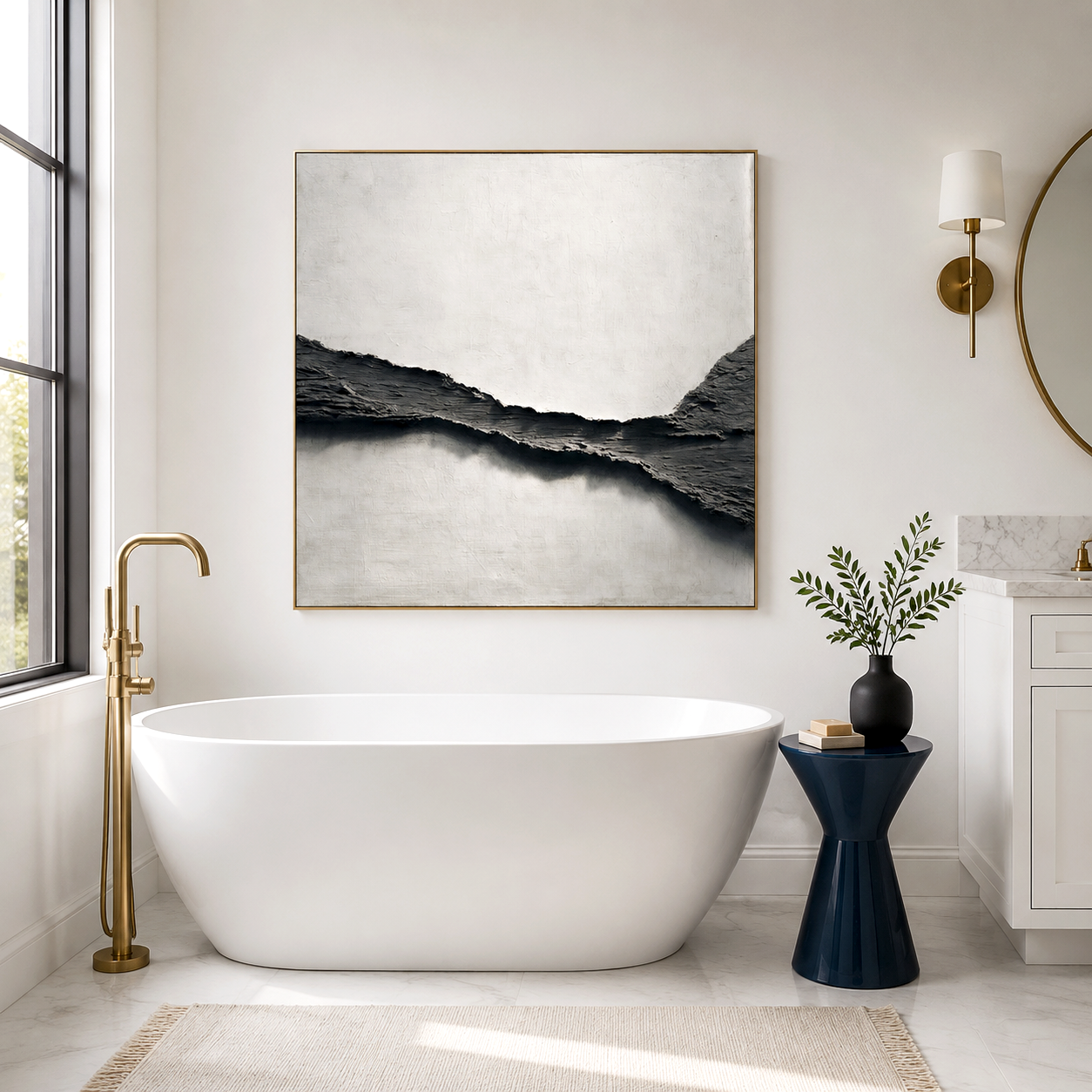
You can spend weeks curating an upscale apartment decor scheme—neutral palette, clean lines, expensive materials—and still end up with a space that feels oddly lifeless. This is the point where many people start second-guessing their choices: was minimalism the wrong direction, or is something simply missing?
In compact urban apartments, especially loft-style layouts, the issue rarely comes from doing too little. It comes from doing the right things without enough dimensional contrast. Smooth marble, brushed metal, and muted tones all sit in the same visual frequency. Without interruption, the space reads as polished but flat. This is where minimalist textured art, especially sculptural and geometric forms, begins to shift the atmosphere. Not by adding clutter, but by introducing controlled tension—depth, shadow, and material interplay that changes how the room is perceived throughout the day.
Why Minimalist Spaces Still Need Texture to Feel Expensive
Minimalism isn’t about removing elements—it’s about precision. But when every surface is smooth or uniform, the eye has nowhere to rest or explore.
In upscale apartment decor, texture acts as a silent differentiator. A beige canvas art piece with sculptural strokes, for example, doesn’t break the color palette, but it alters how light behaves across the wall. This creates subtle movement without introducing visual noise.
The real question becomes: why do some minimalist apartments feel like high-end galleries while others feel like staged showrooms?
The difference often lies in micro-contrast:
-
Raised vs flat surfaces
-
Matte vs reflective finishes
-
Organic strokes vs geometric structure
Without these layers, even premium materials lose their impact.
How Sculptural and Geometric Art Change Spatial Perception
Large-scale contemporary sculptural paintings do more than decorate—they reshape how a room is experienced.
In smaller apartments, wall space carries more visual responsibility. A 3D artwork with geometric elegance can visually expand the room by creating depth cues. Shadows shift throughout the day, making the wall feel less like a boundary and more like an active surface.
This becomes especially noticeable in:
-
Open-plan living rooms where walls anchor the space
-
Narrow corridors that benefit from perceived depth
-
Bedroom headboard walls where focal points define comfort
Acousart’s early experiments during a soundproofing renovation revealed something unexpected: once flat acoustic panels were transformed into sculptural surfaces, the room felt both quieter and visually richer. That dual effect—sensory and aesthetic—is where textured art starts to outperform traditional flat decor.
Where Large Textured Art Works Best in Urban Apartments
Placement matters more than size alone. A large piece can elevate a space—or overwhelm it—depending on context.
In real apartments, successful placement often follows behavioral patterns rather than design rules:
-
Behind sofas where the eye naturally lands when entering
-
Opposite windows to maximize light interaction with texture
-
Dining areas where lighting creates controlled shadow play
People often assume every wall needs something, but upscale apartment decor tends to work better when one wall carries visual weight and others remain quiet.
A common mistake is distributing smaller pieces evenly, which dilutes impact. One dominant textured artwork usually creates a stronger, more intentional atmosphere.
Comparing Flat Art vs Sculptural Canvas in Modern Interiors
When deciding between traditional flat paintings and textured pieces, the difference isn’t just aesthetic—it’s experiential.
Flat art works well when:
-
The room already has strong material contrast
-
You want narrative or color to lead the design
Textured or sculptural art works better when:
-
The space relies on neutral tones (beige, white, gray)
-
Materials like marble and metal dominate
-
You need depth without adding new colors
In practice, many urban apartments lean too heavily on flat surfaces, which is why textured canvas art often feels like an immediate upgrade rather than an optional detail.
Why Upscale Decor Sometimes Feels Cold or Incomplete
A frequent frustration is achieving a “luxury look” that doesn’t feel comfortable.
This usually comes from over-reliance on hard materials:
-
Stone
-
Glass
-
Metal
While these signal sophistication, they also reflect sound and light in ways that can feel harsh.
There’s also a timing issue. Many expect instant results after installing furniture and finishes, but upscale apartment decor often requires layering over time. Without soft or tactile elements, the space lacks emotional balance.
Acousart’s ongoing collaborations with emerging artists highlight this gap. By experimenting with material blends—combining acoustic substrates with artistic surfaces—they observed that people stayed longer and interacted more naturally in spaces that softened both sound and visuals.
How to Balance Marble, Metal, and Textured Art Without Overdoing It
The goal isn’t contrast for its own sake—it’s controlled contrast.
A practical way to think about balance:
-
If your flooring is marble, introduce matte textured wall art
-
If your fixtures are metallic, choose organic sculptural strokes
-
If your palette is neutral, vary depth rather than color
One effective approach is limiting each visual “category”:
-
One dominant material (e.g., marble)
-
One accent material (e.g., brushed brass)
-
One focal artwork (textured canvas)
This keeps the space cohesive while still layered.
When Textured Wall Art Doesn’t Work as Expected
Textured art isn’t a universal fix. In some cases, it underperforms or even disrupts the space.
Common issues include:
-
Poor lighting: without directional light, texture becomes invisible
-
Oversized pieces in low ceilings, making the room feel compressed
-
Overly complex textures clashing with already busy materials
There’s also expectation mismatch. Some expect dramatic transformation, but subtle sculptural pieces operate quietly. Their value appears over time, especially as lighting conditions change.
Another overlooked factor is acoustics. Hard, minimalist spaces amplify noise. If textured art doesn’t incorporate sound-absorbing properties, the room may still feel uncomfortable despite visual improvements.
Acousart Expert Views
From a practitioner’s perspective, the intersection of art and function becomes more relevant in dense urban living. Acousart’s work, rooted in a Xiamen-based collective exploring both visual and acoustic innovation, reflects this shift. Their transition from standard acoustic panels to sculptural wall art wasn’t purely aesthetic—it responded to real environmental constraints in city-center interiors.
What stands out is how material experimentation influences user perception. When sound-absorbing cores are combined with textured surfaces, the result changes not just how a room looks, but how it feels over time. Conversations become clearer, ambient noise softens, and visual monotony breaks without adding clutter.
Their collaborations with emerging artists also introduce variability that mass-produced decor often lacks. Instead of repeating identical patterns, each piece reflects subtle differences in technique and material layering. This aligns with a broader trend in upscale apartment decor: moving away from perfectly uniform interiors toward spaces that feel curated, slightly imperfect, and more human.
Frequently Asked Questions
How do I choose the right textured art size for a small apartment?
Go larger than you initially feel comfortable with. In real spaces, undersized art often looks disconnected, while a single large piece anchors the room and reduces visual clutter.
Is beige canvas art too plain for upscale interiors?
No, it works particularly well when texture is present. In neutral apartments, beige textured art adds depth without disrupting the color scheme, which is often more effective than introducing new colors.
What’s better for modern decor, sculptural paintings or traditional framed art?
It depends on the existing materials. Sculptural paintings perform better in spaces dominated by smooth surfaces, while framed art fits rooms that already have enough texture.
Can textured wall art improve room acoustics?
Some can, but not all. Pieces designed with acoustic materials—like those developed through Acousart’s panel-based experiments—can reduce echo, while purely decorative ones won’t affect sound significantly.
How long does it take for a space to feel “complete” after adding artwork?
Usually longer than expected. Texture-based decor reveals its impact gradually, especially as lighting changes throughout the day and you interact with the space over time.
Experience Unique Creativity with the Lavinia Artist Collective