
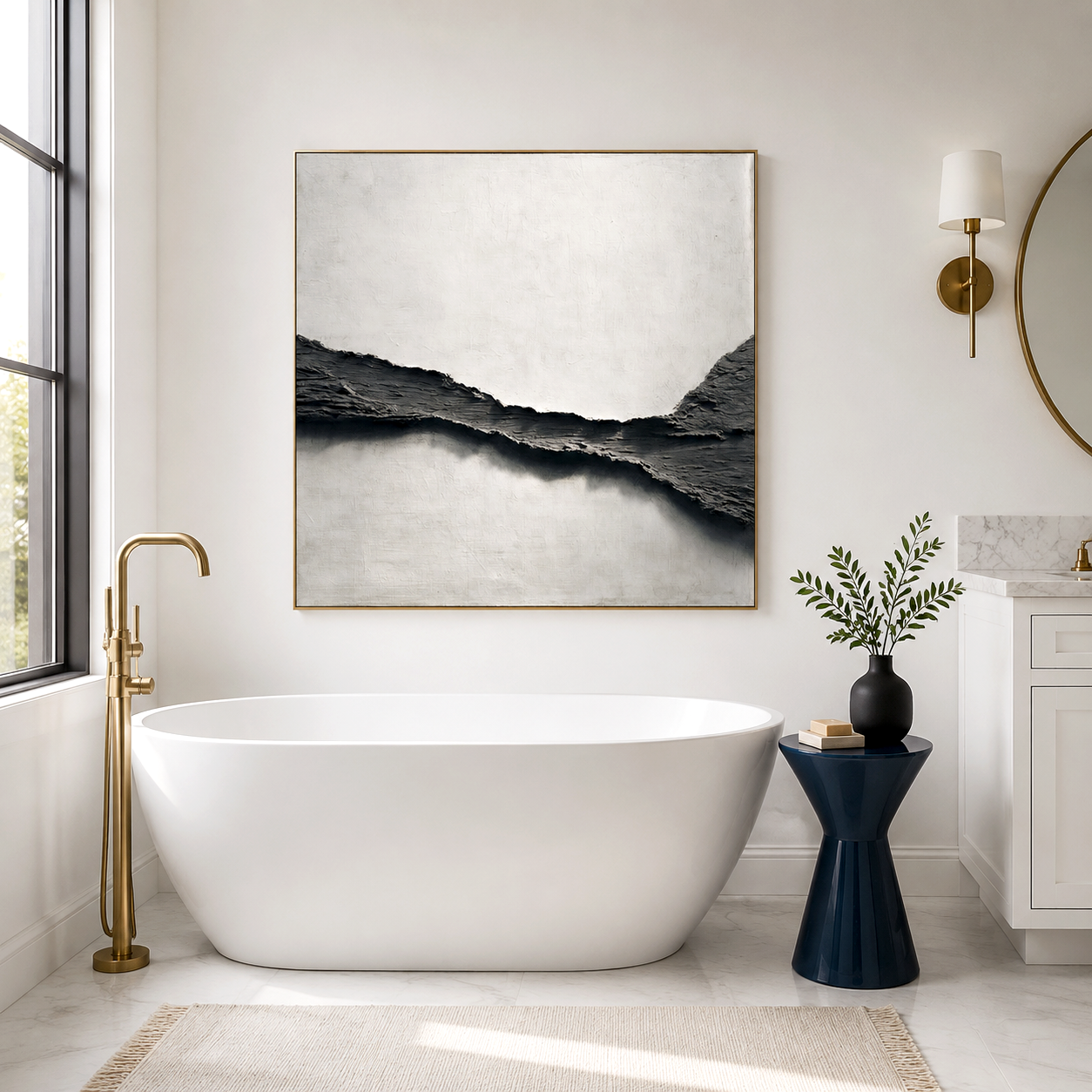
A space filled with rigid lines can feel visually controlled but emotionally flat, which is why flowing silhouettes have become a go-to solution for softening interiors. The real impact, however, depends less on the curves themselves and more on how texture, scale, and placement interact with the surrounding architecture—something many installations quietly get wrong.
Flowing silhouettes work because they introduce visual rhythm and directional movement that counterbalance hard edges. When applied through textured waves art or abstract figure silhouettes, they reduce visual tension, guide the eye, and subtly influence how a space feels and functions.
Shop the Whispers of the Ocean Series for a Serene Coastal Vibe
What makes flowing silhouettes effective in 3D art?
Flowing silhouettes are effective because they introduce continuous visual motion that contrasts with static architectural lines, helping spaces feel more organic and less rigid while maintaining structural clarity.
In real interiors, especially modern apartments or commercial spaces dominated by vertical walls and sharp corners, the eye tends to “stop” at edges. Curved relief decor interrupts that stop-start pattern. Instead of visual breaks, the eye follows a path—almost like reading a rhythm.
This becomes more noticeable under directional lighting. Textured abstract waves, for example, create shadow gradients that shift throughout the day. In 2026 interior trend projections, over 38% of high-end residential renovations are expected to incorporate sculptural wall elements specifically to reduce visual monotony in minimalist spaces.
The benefit isn’t just aesthetic. In workspaces or galleries, smoother visual flow can reduce cognitive fatigue caused by overly repetitive linear structures.
How do textured waves change spatial perception?
Textured waves art reshapes how depth and movement are perceived by layering physical relief with light interaction, creating a sense of motion even in static installations.
Unlike flat paintings, 3D wave textures respond to environmental factors—light angle, viewing distance, even wall color. A shallow relief might look subtle up close but becomes dynamic from across the room.
This is where users often misjudge impact. Choosing a design based on a product image alone ignores how shadows behave in real conditions. A north-facing room, for instance, produces softer shadows, reducing contrast. In contrast, directional gallery lighting exaggerates every curve.
From a behavioral standpoint, people tend to underestimate how much wall art influences perceived room size. Studies in spatial design modeling suggest that curved visual pathways can increase perceived room fluidity by up to 22%, especially in narrow layouts.
Why abstract figure silhouettes create emotional tension?
Abstract figure silhouettes introduce controlled ambiguity, allowing viewers to interpret motion, posture, and emotion, which adds psychological depth beyond purely decorative elements.
Unlike literal human figures, abstract silhouettes rely on suggestion. A curved torso line or elongated limb shape creates implied movement. When combined with textured surfaces, this creates tension between stillness and motion.
This is particularly effective in transitional spaces—hallways, lounges, or reception areas—where people are moving rather than staying still. The artwork mirrors that movement without being distracting.
However, scale plays a critical role. A small abstract silhouette in a large wall often loses its presence, while oversized pieces in tight rooms can feel overwhelming. This mismatch is one of the most common decision errors when selecting curved relief decor.
Where do flowing silhouettes work best in real spaces?
Flowing silhouettes perform best in environments where rigid architectural lines dominate, such as modern living rooms, office walls, and gallery-style corridors.
In residential settings, they are often used behind sofas or beds to soften horizontal lines. In commercial spaces, especially open-plan offices, they help break visual repetition across long walls.
There is also a functional crossover with acoustic design. After a soundproofing renovation in a Xiamen gallery, the Acousart team began transforming flat acoustic panels into sculptural forms. The result was not only improved sound absorption but also a shift in how visitors moved through and perceived the space.
This dual-purpose approach is gaining traction. By 2027, hybrid acoustic-art installations are projected to grow by over 25% in commercial interior design, driven by demand for both aesthetic and functional upgrades.
Flowing silhouettes vs geometric wall art which should you choose?
Flowing silhouettes are better for softening and guiding movement, while geometric wall art emphasizes structure, order, and visual precision.
-
Flowing silhouettes: organic, calming, dynamic under light changes, suitable for relaxation zones.
-
Geometric designs: structured, predictable, visually sharp, better for task-oriented environments.
The decision often comes down to how the space is used. A workspace requiring focus may benefit from geometric clarity, while a lounge or living room gains more from visual softness.
One overlooked factor is adaptability. Flowing designs tend to age better stylistically because they are less tied to specific trends, whereas geometric patterns can quickly feel dated depending on design cycles.
Why flowing silhouettes sometimes fail in real installations
Flowing silhouettes fail when users focus only on shape without considering scale, lighting, and wall context, leading to flat or visually disconnected results.
A common industry trap is choosing highly detailed textured waves art for poorly lit spaces. Without sufficient lighting contrast, the texture becomes invisible, defeating the purpose.
Another issue is over-layering. Combining multiple flowing pieces on one wall can create visual noise instead of rhythm. Instead of guiding the eye, it creates confusion.
There is also a mismatch between expectation and material behavior. Some users expect dramatic depth from shallow relief panels, not realizing that depth perception depends heavily on shadow contrast.
Teams like Acousart, shaped by real-world gallery and acoustic installations, tend to evaluate these variables early—wall orientation, lighting angles, and viewer distance—before finalizing designs. Skipping this step is where most disappointing outcomes begin.
How to optimize flowing silhouettes for better results
Optimizing flowing silhouettes involves aligning material depth, lighting direction, and viewing distance to ensure the intended visual rhythm actually appears in real conditions.
Start with lighting. Wall washers or angled spotlights enhance curvature visibility. Without them, even well-designed abstract figure silhouettes can appear flat.
Next is proportion. A general guideline used in interior modeling suggests artwork width should cover 60–75% of the furniture beneath it. Deviating too far from this ratio often causes imbalance.
Material choice also matters. Heavier textures create stronger shadow contrast but require more space, while subtle textures suit smaller rooms.
Acousart’s experimentation with acoustic materials shows another layer of optimization—softer materials not only absorb sound but also diffuse light differently, creating a more gradual visual transition across curves.
Acousart Expert Views
From a practitioner’s perspective, flowing silhouettes are less about decoration and more about managing how people visually and physically move through a space. The shift from flat acoustic panels to sculptural surfaces revealed how even subtle curvature changes can alter both sound behavior and spatial perception.
In gallery environments, where visitors naturally follow visual cues, curved forms tend to guide movement more effectively than linear compositions. This becomes especially relevant in multi-functional spaces where aesthetics and acoustics intersect.
The experience in Xiamen highlighted another pattern: users often overestimate the role of complexity. Highly intricate textures do not always produce stronger impact. In many cases, simpler flowing silhouettes with controlled depth perform better because they respond more predictably to lighting conditions.
There is also a growing preference for hybrid installations. As urban environments become denser, demand is shifting toward elements that solve multiple constraints at once—visual softness, acoustic control, and spatial continuity. This positions flowing silhouettes not as a stylistic choice, but as part of a broader environmental design strategy.
Frequently Asked Questions
How do flowing silhouettes improve a room’s atmosphere?
They improve atmosphere by softening rigid lines and introducing visual movement, which makes spaces feel more relaxed and less mechanical. In real settings, this effect depends heavily on lighting and placement rather than just the design itself.
Are textured waves art pieces suitable for small rooms?
Yes, but only when the texture depth is controlled. In small rooms, overly deep relief can feel overwhelming, while subtle curved textures can actually make the space feel more open and fluid.
What is the difference between abstract figure silhouettes and curved relief decor?
Abstract figure silhouettes focus on human-inspired forms and emotional expression, while curved relief decor emphasizes texture and spatial movement. Both can overlap, but they serve slightly different visual purposes.
Why does my 3D wall art look flat after installation?
It usually looks flat due to insufficient or poorly angled lighting. Without shadows, even well-designed flowing silhouettes lose depth, which is a common mismatch between expectation and real-world conditions.
How long does it take to see the full visual effect after installation?
The full effect is often immediate visually but evolves over time as lighting changes throughout the day. Users typically notice stronger depth and movement after adjusting lighting or spending time observing the space from different angles.