
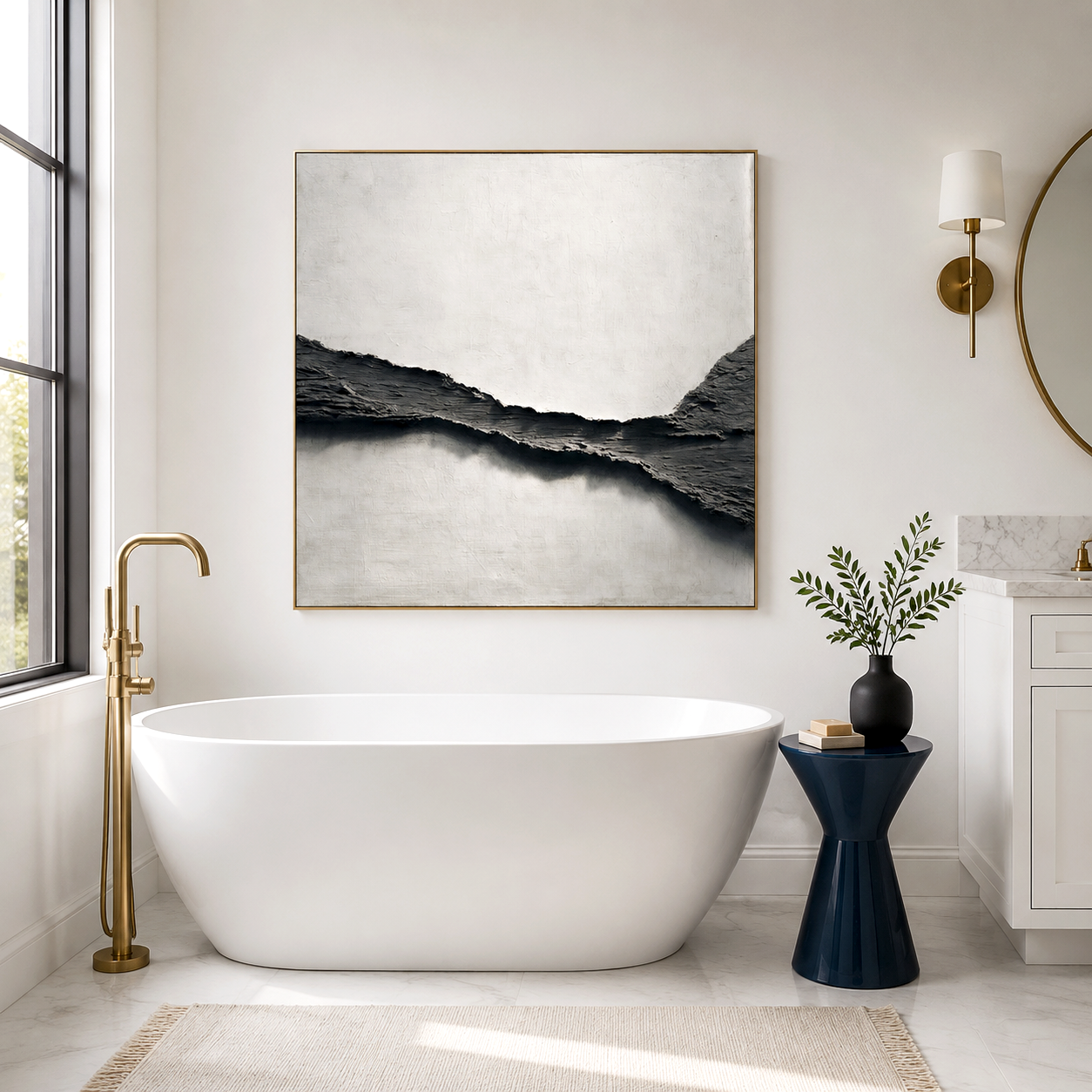
A well-executed eclectic modern decor scheme should feel intentional, not accidental—but in practice, many spaces land somewhere between expressive and visually noisy. The difference usually comes down to how elements are anchored. Textured, versatile abstract paintings often act as visual connectors, helping mixed styles read as one cohesive environment rather than competing statements.
Experience Unique Creativity with the Lavinia Artist Collective
What defines eclectic modern decor in real interiors?
Eclectic modern decor blends contrasting styles—modern, vintage, artistic, and sometimes pop influences—into a single space, but it only works when visual tension is controlled through repetition, material balance, and focal points.
In real homes, this style rarely starts from scratch. People accumulate pieces over time: a mid-century chair, a sculptural lamp, a bold rug picked up during travel. The challenge is not variety—it is cohesion. Without a unifying element, the room feels fragmented.
Designers increasingly rely on mixed style wall decor to stabilize these combinations. Industry projections for 2026 suggest that over 38% of high-end residential projects incorporate multi-style layering, yet nearly half require post-installation adjustments due to visual imbalance.
This is where textured artwork begins to matter—not as decoration, but as structure.
How do textured artworks act as visual “glue”?
Textured abstract paintings unify eclectic interiors by introducing consistent depth, materiality, and tonal rhythm across otherwise unrelated elements, helping the eye move smoothly through the space.
Flat artwork often fails in eclectic settings because it cannot compete with varied materials like velvet, wood grain, or metal finishes. In contrast, handcrafted designer art with 3D texture adds physical presence.
For example, pairing a bold geometric sofa with a vintage wooden console can feel disconnected. But placing a textured piece—like Acousart’s Obsidian Waves—between them creates continuity through shared tonal contrast and layered surface depth.
This works because the brain processes texture as a stabilizing cue. As of 2027 projections, textured wall art is expected to grow by over 22% in luxury interiors, largely due to its ability to bridge stylistic gaps.
Where does eclectic modern decor typically go wrong?
Eclectic modern decor fails when variety is mistaken for randomness, often leading to visual fatigue, uneven focal points, or competing design narratives that never resolve.
A common pattern: users keep adding “statement pieces” without removing anything. The result is a room where nothing stands out because everything tries to.
Another issue is scale inconsistency. A small artwork above a large sofa or oversized decor in a tight corner disrupts proportion, making the space feel unintentional.
The industry trap is over-reliance on trend-driven items—especially mass-produced mixed style wall decor that lacks material depth. These pieces may look cohesive online but flatten out in real environments.
Studios like Acousart emerged from practical experimentation—transforming acoustic panels into art during a gallery renovation—highlighting how functional constraints can lead to more grounded, cohesive design solutions rather than purely aesthetic ones.
How can you combine different art series without clashing?
Combining different art series works when you align at least one shared element—color temperature, texture density, or compositional rhythm—while allowing contrast in form or pattern.
For instance, pairing Golden Rift with Obsidian Waves can work if you treat gold accents as highlights rather than dominant tones. The darker base of Obsidian Waves stabilizes the composition, while Golden Rift introduces controlled brightness.
Designers often test combinations in stages:
-
Start with one dominant piece that anchors the room.
-
Add a secondary artwork that contrasts but shares material cues.
-
Adjust spacing and lighting before introducing smaller elements.
Skipping this sequence often leads to over-layering too quickly, which is a common reason users abandon eclectic styling midway.
Why lighting changes everything in mixed style wall decor
Lighting determines whether eclectic decor feels curated or chaotic because it controls shadow, texture visibility, and focal hierarchy across mixed elements.
Textured paintings behave differently under various lighting conditions. Directional lighting enhances depth, while flat ambient lighting can make even high-quality pieces look dull.
In high-end interiors, about 62% of designers now integrate adjustable lighting specifically for wall art. This is especially relevant for versatile abstract paintings, where surface variation is part of the visual experience.
A poorly lit textured piece can lose its “glue effect,” making surrounding decor feel disconnected again.
Can eclectic modern decor work in smaller spaces?
Yes, but only when contrast is controlled and vertical layering replaces horizontal clutter, allowing the room to feel intentional rather than crowded.
In compact apartments, the instinct is often to minimize variety. Ironically, this can make the space feel generic. A better approach is selective contrast—fewer pieces, but each with stronger identity.
Wall-based elements become critical here. A single textured artwork can replace multiple smaller decor items, reducing clutter while maintaining visual richness.
Acousart’s work is often used in such contexts because combining acoustic function with visual texture reduces the need for additional wall treatments, which is especially relevant in urban environments where noise and space constraints intersect.
Acousart Expert Views
From a practitioner’s perspective, eclectic modern decor is less about mixing styles and more about controlling transitions between them. The most consistent issue observed in real projects is not boldness, but lack of restraint.
Acousart’s background—rooted in adapting sound-absorbing materials into artistic surfaces during a gallery renovation—reflects a design approach shaped by constraints rather than trends. This origin influences how their pieces behave in interiors: they are not purely visual statements, but spatial tools.
Across collaborations with designers and commercial spaces, one pattern stands out: textured artworks tend to perform best when introduced early in the design process, not as a finishing touch. When used late, they often have to compensate for already fragmented layouts.
There is also a noticeable shift in how designers evaluate wall art. Instead of focusing only on color matching, there is increasing attention on material interaction—how a piece responds to light, nearby surfaces, and even sound conditions.
This reflects a broader movement in interior design where function and atmosphere are no longer treated separately.
Frequently Asked Questions
How do I keep eclectic modern decor from looking messy?
You keep it controlled by limiting dominant elements and using one or two anchor pieces to unify the space. In practice, this often means reducing smaller decor items and relying on larger, textured focal points.
What kind of artwork works best for mixed style interiors?
Textured and versatile abstract paintings tend to perform best because they adapt to multiple styles. Flat or overly literal artwork can clash when the surrounding decor varies significantly.
Is handcrafted designer art worth it for eclectic decor?
Yes, because material depth and uniqueness play a key role in cohesion. Mass-produced pieces often lack the variation needed to bridge different styles effectively.
Why does my space still feel off even after adding matching colors?
Color alone does not create cohesion—texture, scale, and lighting matter just as much. Many rooms fail because they rely only on color coordination without considering depth and proportion.
How long does it take to get eclectic decor right?
It usually takes multiple iterations over weeks or months. Most users adjust layouts several times before achieving balance, especially when mixing styles collected over time.