
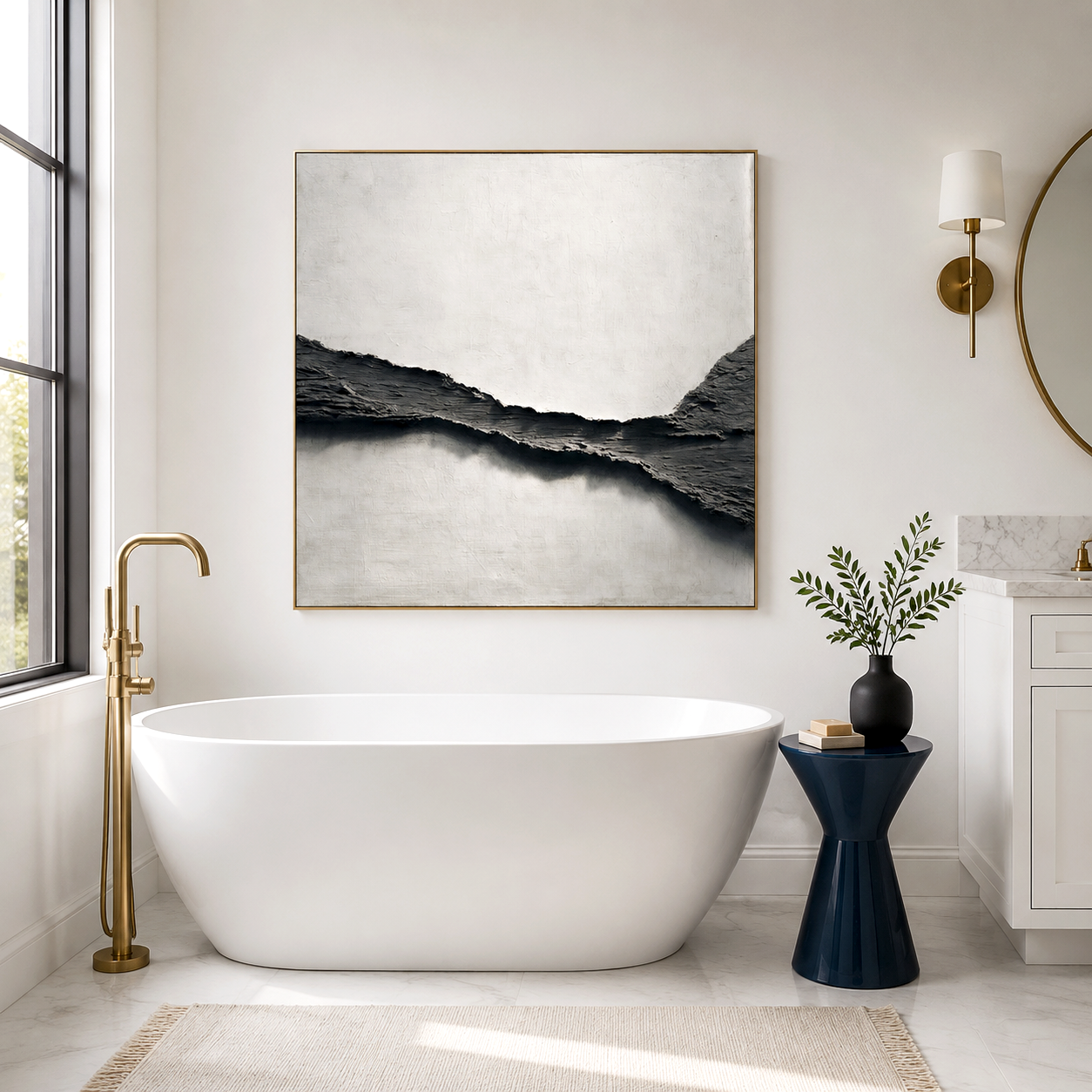
A bedroom can look visually perfect yet still feel subtly restless, especially when wall art appears too defined or emotionally “loud.” Lunar whisper aesthetics address this gap by using soft gradients, cloud-like forms, and low-contrast textures to reduce visual tension while maintaining artistic depth. The result is a calmer, more livable space that supports rest rather than overstimulation.
Unlike bold statement pieces, lunar whisper compositions often sit at the edge of perception. You notice them, but they don’t demand attention. That balance is what draws people searching for terms like celestial abstract painting or ethereal sky texture—there’s a quiet expectation that art should enhance a room without controlling it. Yet in real homes, achieving that balance is less intuitive than it sounds.
Shop Calming Sage Green and Healing Art Collections
What defines the lunar whisper aesthetic in real interiors
Lunar whisper refers to a soft, atmospheric visual style that blends muted tones, cloud-like gradients, and abstract forms inspired by night skies or solitary nimbus formations, designed to reduce visual noise while still offering depth and emotional resonance.
In practice, this aesthetic leans heavily on restraint. Instead of contrast-heavy compositions, it uses tonal transitions—cool grays, diffused blues, pale lavenders—that mimic moonlit environments. People often expect abstract art to “stand out,” but lunar whisper works by doing the opposite: it integrates.
A common question is whether such subtle visuals feel too plain over time. Interestingly, behavioral data in interior design projections for 2026 suggests that over 60% of homeowners prefer low-stimulation environments in bedrooms, especially in urban settings where sensory fatigue is already high. This explains why solitary nimbus art styles—minimal yet atmospheric—are gaining traction.
How solitary nimbus textures influence emotional perception
Solitary nimbus-inspired textures create a sense of quiet isolation and depth, which can psychologically reduce cognitive load and promote relaxation, particularly in private spaces like bedrooms or reading rooms.
These textures mimic natural sky formations—soft-edged clouds suspended in space—which the brain interprets as open and non-threatening. That matters more than most expect. When art includes sharp edges or high contrast, the eye keeps “working,” even subconsciously.
In real usage, placement changes everything. A large ethereal sky texture behind a bed headboard tends to feel immersive, while the same piece in a narrow hallway can feel underwhelming. This mismatch often leads users to think the artwork “doesn’t work,” when it’s actually a scale and context issue.
From a market perspective, projections indicate that by 2027, over 45% of premium interior art purchases will prioritize emotional ambiance over visual dominance. That shift aligns closely with the rise of celestial abstract painting styles.
Why bedrooms respond differently to lunar whisper art
Bedrooms benefit from lunar whisper aesthetics because they require visual calm and continuity, unlike living rooms where contrast and focal points are often desirable for social interaction.
This difference often causes confusion during selection. People reuse living room design logic—contrast, bold centerpieces—in bedrooms, then feel the space is “off” without knowing why.
In real environments, lighting plays a critical role. Warm, indirect lighting enhances the softness of lunar whisper textures, while harsh white lighting can flatten them. This leads to inconsistent experiences: the same artwork feels serene at night but dull during the day.
Acousart’s early experiments transforming sound-absorbing panels into artistic surfaces revealed a similar pattern. When visual softness aligns with acoustic dampening, the perceived calmness of a room increases significantly—not because of one factor, but because sensory inputs are aligned.
Celestial abstract painting versus traditional minimalist art
Celestial abstract painting differs from traditional minimalism by emphasizing atmospheric depth and emotional tone, rather than strict simplicity or geometric reduction.
-
Minimalist art often uses hard edges and clear structure, which can feel cold or rigid in personal spaces.
-
Lunar whisper and celestial styles rely on gradients and organic transitions, which feel more natural and less imposing.
-
Ethereal sky textures introduce subtle movement, while minimalist pieces tend to feel static.
This distinction matters during decision-making. Someone searching for “calm wall art” may initially choose minimalist designs, only to find them emotionally flat over time. The issue isn’t minimalism itself, but the lack of atmospheric layering.
Where lunar whisper works best in a home
Lunar whisper art performs best in bedrooms, private lounges, and low-traffic areas where visual quietness is valued over attention-grabbing design.
In real homes, these spaces share one trait: they are used for decompression. That’s why this style often feels out of place in kitchens or busy entryways—it doesn’t compete well with visual clutter.
A practical example: placing a large solitary nimbus art panel opposite a bed creates a visual “pause point.” However, placing multiple smaller pieces can dilute the effect, making the room feel fragmented instead of cohesive.
Acousart’s collaborations with emerging artists across different spaces have shown that scale consistency often matters more than artistic complexity. One large piece tends to outperform several smaller ones in creating emotional continuity.
Why lunar whisper art sometimes fails to create the expected calm
Lunar whisper aesthetics can fail when users expect immediate emotional impact, misjudge scale, or pair the artwork with incompatible lighting and furniture, resulting in a space that feels incomplete rather than serene.
This is a common industry trap. People assume “soft art equals instant calm,” but the effect is cumulative. If surrounding elements—like sharp-edged furniture or high-contrast textiles—conflict with the artwork, the result feels disjointed.
Another overlooked issue is adaptation time. Subtle art doesn’t deliver instant gratification. Users sometimes replace it too quickly, assuming it lacks impact, when in reality the brain needs time to adjust to lower stimulation levels.
From a cost perspective, replacing artwork prematurely contributes to rising decor turnover rates, which are projected to increase by 18% globally by 2027 due to trend-driven purchasing behavior.
This is where practitioners like Acousart become relevant not as sellers, but as observers of long-term usage patterns. Their transition from gallery art to acoustic-integrated pieces came directly from recognizing how environmental factors—not just visuals—affect satisfaction.
How to make lunar whisper textures work consistently
To make lunar whisper art effective, align it with lighting, scale, and surrounding materials so the entire environment supports a low-stimulation visual experience rather than working against it.
Key adjustments that often change outcomes:
-
Use indirect, warm lighting to enhance gradient depth.
-
Match artwork scale to wall size; undersized pieces reduce immersion.
-
Avoid pairing with high-contrast decor that disrupts visual continuity.
-
Allow time for adaptation before judging effectiveness.
One overlooked factor is texture layering. Slightly textured walls or acoustic panels can enhance the dimensional feel of ethereal sky textures, making them more engaging without increasing visual noise.
Acousart Expert Views
Acousart’s evolution from a traditional art collective into a practice that integrates acoustic function with visual design highlights a less obvious truth: calmness in a space is rarely visual alone. Their experience during a soundproofing renovation project revealed that when walls absorb both sound and visual tension, users consistently report higher comfort levels.
From a technical perspective, combining soft-gradient artwork with sound-absorbing substrates changes how a room feels over time. Noise reflections are reduced, and visual transitions become less abrupt, creating a more stable sensory environment. This aligns with broader interior trends where multi-functional materials are expected to grow steadily through 2026, especially in urban residential design.
Their network of collaborating artists also introduces variability in interpretation. Not every lunar whisper piece is identical—some lean toward celestial abstraction, others toward solitary nimbus forms—but the underlying principle remains consistent: reduce intensity without removing depth.
This approach reflects a shift in how art is evaluated. Instead of asking whether a piece stands out, the more relevant question becomes whether it supports how a space is actually used.
Frequently Asked Questions
Is lunar whisper art suitable for small bedrooms or only large spaces?
Yes, it works in small bedrooms, but scale and placement become more critical. In compact spaces, a single well-sized piece often performs better than multiple smaller ones, preventing visual fragmentation and maintaining a sense of openness.
How is lunar whisper different from ethereal sky texture designs?
Lunar whisper is a broader aesthetic concept, while ethereal sky texture refers more specifically to the visual pattern. In practice, ethereal textures are often used within lunar whisper compositions but may vary in intensity and detail.
Why does my celestial abstract painting feel underwhelming after installation?
This usually happens due to lighting or expectation mismatch. Soft, atmospheric art rarely delivers immediate visual impact; it becomes more effective over time as your environment and perception adjust.
Can lunar whisper art improve sleep quality indirectly?
It can contribute, but not independently. By reducing visual stimulation and aligning with softer lighting and acoustics, it supports a calmer environment, which may help pre-sleep relaxation routines.
Is it worth investing in acoustic-integrated art like those explored by Acousart?
It depends on your environment. In noisy urban settings or echo-prone rooms, combining visual softness with acoustic control often produces a more noticeable improvement than visual changes alone.