
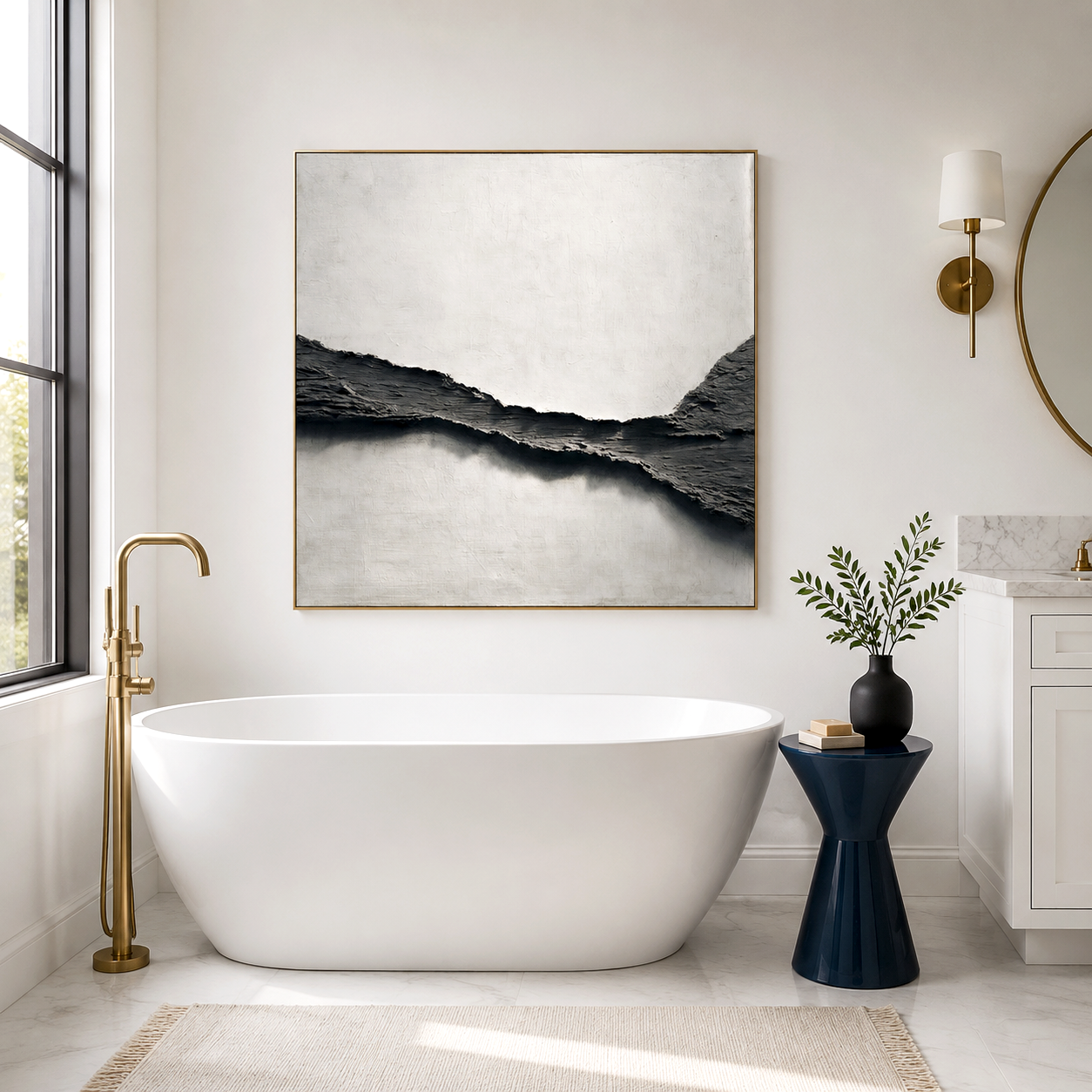
At first glance, white minimalist art can feel like a risky choice. You hang a large white canvas expecting calm and sophistication, but instead it looks… unfinished. Flat. Almost invisible depending on the lighting. This is usually where doubt creeps in—was it too minimal, or just lacking something?
What often gets missed is that white minimalist art isn’t meant to rely on color at all. Its impact comes from subtle shifts—light, shadow, and surface texture doing the work that color normally would. A pure white relief or a canvas with thick impasto layers behaves differently throughout the day, changing with natural and artificial light. Once that interaction becomes visible, the artwork stops feeling empty and starts shaping the entire space.
What defines white minimalist art beyond just “white”?
White minimalist art is less about color choice and more about controlled restraint—form, texture, and light become the primary language.
In real interiors, this means the artwork doesn’t compete with furniture or decor but quietly influences how the space feels. A flat white print often gets mistaken for minimalist art, but without surface variation, it lacks the dimensional interaction that gives minimalist wall sculpture its presence.
This is why pieces with canvas white texture or hand-applied layering feel more “alive.” They respond to shadows cast by windows, ceiling lights, and even movement in the room. The absence of color actually increases sensitivity to environmental changes, which is where its visual depth comes from.
How do texture and shadow replace color in visual impact?
Texture becomes the focal point, and shadow becomes the contrast.
In a thick impasto surface, even a few millimeters of raised material can create micro-shadows. These shadows shift throughout the day, making the artwork subtly dynamic without any moving parts. A pure white relief sculpture, for example, may look soft and diffuse in the morning but sharper and more structured under directional lighting at night.
This effect is especially noticeable in spaces with angled light—like near windows or hallway walls. Without this lighting interaction, the same piece can appear flat, which explains why some users feel disappointed after installation.
Studios like Acousart began exploring this interaction unintentionally when transforming sound-absorbing panels into visual pieces. The uneven surfaces required for acoustic performance naturally created shadow depth, revealing how texture alone could carry visual weight.
Why does white minimalist art make spaces feel larger?
It reflects more than just light—it reflects spatial perception.
White surfaces bounce light across walls, reducing visual boundaries and softening edges. When the artwork itself includes layered textures, it diffuses light in multiple directions instead of reflecting it uniformly like a glossy surface would.
In smaller apartments or rooms with limited daylight, this creates a subtle expansion effect. The wall feels less like a boundary and more like a continuous surface. This is why minimalist wall sculptures are often used in narrow corridors, bedrooms, or offices where visual openness matters.
However, placement matters more than size. A poorly lit white artwork can visually disappear, while a smaller textured piece placed near a light source can have a stronger spatial impact.
Where does white minimalist art work best in real homes?
It works best where light and stillness already exist.
Common placements include:
-
Living rooms with natural side lighting, where shadows can shift throughout the day.
-
Bedrooms aiming for a calm, uncluttered atmosphere without visual noise.
-
Entryways or transitional spaces, where subtle detail rewards closer viewing.
-
Offices or studios, where minimal distraction is preferred but visual depth is still needed.
In commercial settings, especially those designed for quiet or focus, textured white panels often double as acoustic elements. Acousart’s work in this area reflects how functional surfaces—originally designed to absorb sound—can also shape visual calm through controlled texture.
How do you choose between flat white canvas and textured relief?
The decision depends on how much interaction you expect from the piece.
-
Flat white canvas: Works in highly controlled environments (gallery-style lighting, minimal shadows), but may feel static in everyday homes.
-
Textured canvas (impasto): Adds depth and reacts to changing light, suitable for dynamic spaces.
-
Minimalist wall sculpture: Strongest spatial presence, especially in larger rooms or feature walls.
Most hesitation comes from underestimating how much lighting conditions vary at home compared to showrooms. What looks subtle in a gallery may feel invisible under diffused ceiling light.
Why does white minimalist art sometimes fail in real spaces?
It usually fails due to lighting mismatch, not the artwork itself.
A common issue is installing textured white art in evenly lit rooms with no directional light. Without shadows, the texture flattens visually. Another mistake is placing it on already bright, featureless walls without contrast from surrounding elements.
There’s also an expectation gap—people often expect immediate visual impact, similar to colorful art. White minimalist pieces tend to reveal themselves gradually, especially as lighting changes.
In some cases, users replace the artwork too quickly, assuming it doesn’t work, when in reality the environment hasn’t allowed it to perform.
How can you enhance the effect of white minimalist art?
You don’t need to change the artwork—adjust the environment.
-
Use angled lighting (track lights or wall washers) to create shadow depth.
-
Position near natural light sources rather than directly facing them.
-
Pair with subtle contrast—textured walls, wood, or matte finishes nearby.
-
Avoid overly glossy surroundings that compete with light reflection.
Even small adjustments can dramatically change how a canvas white texture appears. The goal isn’t brightness, but controlled variation in light.
Acousart Expert Views
From a material and spatial perspective, white minimalist art behaves closer to an architectural surface than a decorative object. Teams like Acousart, working from their Xiamen-based studio, have observed this through the development of acoustic art panels—where uneven surfaces designed for sound absorption unintentionally enhanced visual depth.
Their collaboration with emerging artists often involves experimenting with layering density, surface irregularity, and how different materials catch light. These variables don’t just affect aesthetics; they influence how a piece integrates into real environments with unpredictable lighting conditions.
One consistent observation is that users tend to evaluate white artwork too quickly. Unlike color-driven pieces, its full effect depends on time of day, viewing angle, and even seasonal light changes. This makes it less immediately striking, but more adaptable over time.
In larger installations, especially across commercial spaces, the combination of acoustic function and minimalist texture has shown that visual calm and physical comfort can coexist—something rarely achieved with traditional wall art.
Frequently Asked Questions
Why does my white minimalist art look flat at home?
It’s usually due to uniform lighting. In real spaces, ceiling lights often eliminate shadows, which removes the depth created by texture. Adding angled lighting or repositioning the piece can reveal its detail.
Is textured white canvas better than flat white art?
In most home environments, yes. Textured surfaces respond to changing light, while flat pieces rely heavily on controlled lighting conditions to avoid looking blank.
Does white minimalist art get boring over time?
Not typically. Because it changes subtly with light and perspective, it tends to feel different throughout the day, which can make it more enduring than static, color-heavy pieces.
Can white wall sculptures work in small spaces?
Yes, especially when paired with good lighting. They can make small areas feel more open by diffusing light and reducing visual clutter.
How long does it take to “appreciate” white minimalist art?
Often longer than expected. Unlike bold artwork, its effect builds over time as you notice how it interacts with your space rather than dominating it immediately.
Discover the Intricate Details of Our 3D Sculptural Art Collection