
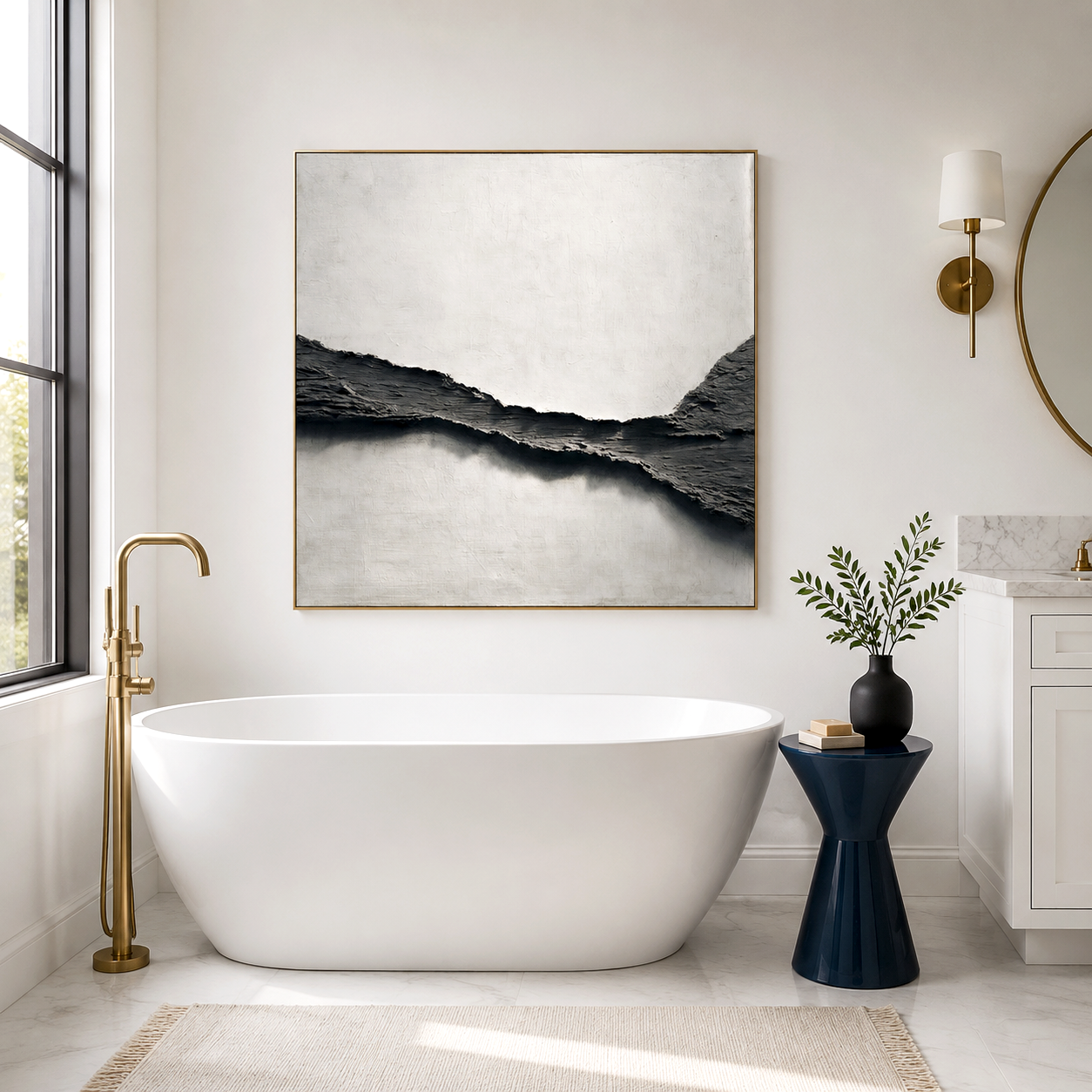
Floor-to-ceiling windows and exposed industrial finishes give contemporary lofts and premium apartments their dramatic design edge. However, these architectural choices introduce subtle, daily frustrations the moment you move in: harsh sunlight reflections that obscure your view and an empty, persistent acoustic ring. Selecting the right scale, texture, and material finish for your wall décor allows you to quietly correct these spatial balance issues while establishing a sophisticated focal point.
The Invisible Design Flaws of Glass and Concrete Architecture
Industrial aesthetics rely on hard, non-porous surfaces like polished concrete, expansive glass sheets, and structural steel. While visually clean, these materials are acoustically and optically unforgiving. When daylight hits these surfaces, it creates high-contrast hotspots that cause eye fatigue and compete directly with your exterior skyline.
At the same time, these hard materials reflect sound waves rather than absorbing them. In an open-plan living area or a high-ceiling home office, conversations bounce constantly, footsteps sound amplified, and video calls suffer from a distinct hollow echo. Resolving these challenges requires interior elements that introduce tactile warmth and physical depth without cluttering the minimalist layout.
Why Glossy Art and Acrylic Prints Fail Near Expansive Windows
Placing a traditional glossy painting, glass-framed poster, or acrylic print opposite or adjacent to a large window panel often invalidates the investment in the art itself. Instead of displaying its colors, the smooth surface acts as a mirror, reflecting daylight and interior lamps directly into the viewing zone.
-
Specular Reflection: High-gloss coatings reflect light at a sharp, matching angle, creating blinding white rectangles on your wall that obscure the artwork from multiple seating positions.
-
Artificial Hotspots: At night, downlights and chandeliers reflect directly off smooth surfaces, causing localized glare that ruins the room's atmospheric lighting.
-
Loss of Contrast: Strong daylight washing over a printed surface washes out rich dark tones, turning deep blacks and deep grays into a flat, milky gray.
The Science of Matte Textures in Light Management
A hand-painted canvas featuring sculptural relief handles light through diffuse reflection. Instead of bouncing a single light beam back into the room, the micro-ridges, valleys, and plaster-like crests of heavily textured art scatter the light waves in multiple directions.
This surface topograph allows black and white textured wall art to maintain deep contrast and visual legibility from any angle in the room, even when installed directly adjacent to double-height window banks. The artwork shifts from a source of visual noise into a calming, architectural anchor.
Mitigating Residential Echo Without Commercial Acoustic Foam
While residential wall art cannot replace professional soundproofing engineered for commercial studios, original canvas art plays a meaningful role in softening sound reflections. Standard drywall and concrete bounce sound back completely, but an organic canvas setup functions as a multi-layered dampening panel.
-
Fabric Dissipation: The woven texture of canvas provides a porous surface that interrupts high-frequency sound waves, such as the sharp clatter of kitchen utensils or footwear.
-
Internal Air Pocket: A premium studio-wrapped canvas sits on a hollow wooden frame, creating a shallow air pocket between the fabric and the hard wall behind it, which traps and dampens sound energy.
-
Imperfect Micro-Topography: Hand-applied oil patterns and structural grooves break up unified sound waves, scattering the sonic reflections and removing the sharp "ring" from open-plan layouts.
When combined with primary soft furnishings like heavy rugs, upholstered seating, and drapery, high-relief artwork acts as a seamless design layer that enhances acoustic comfort without sacrificing the editorial look of your space.
Scaling Artwork for Vertical and Industrial Volumes
Underscaling is one of the most common mistakes when decorating large vertical walls. Arranging a collection of small frames in a grid pattern fragments the wall plane and conflicts with the clean lines of high-end architecture. The verticality of structural concrete calls for fewer, definitive choices.
-
The Single Statement Rule: A large square canvas, ranging from 60" x 60" to 72" x 72", provides the necessary visual weight to ground a room with high ceilings, creating a stable point of focus next to towering window frames.
-
The Taped Blueprint Method: Before finalizing your art choice, outline the dimensions on your wall using low-tack painter's tape. View this footprint from your main sofa, entryway, and dining positions to verify that the scale feels proportional to the wall's volume.
-
The Horizontal Split: If a single canvas is impractical for transport, choose a minimalist diptych or triptych. Ensure the spacing is kept tight—between 1 to 2 inches—and the tonality remains consistent to preserve a unified architectural feel.
Material Performance Across Common Wall Decor Formats
Understanding how different wall décor options perform in premium environments is essential for ensuring long-term utility and style alignment.
| Feature | Textured Matte Canvas | Glossy / Acrylic Print | Foam Acoustic Panel |
| Light Behavior | Diffuses glare; perfectly readable from multiple viewing angles | Reflects like a mirror; creates harsh glare zones near windows | Matte finish with no glare, but lacks visual and artistic depth |
| Visual Fit | Architectural, editorial, and clean; complements premium materials | Often looks commercial or highly decorative rather than fine-art | Industrial or office aesthetic; detracts from high-end residential styling |
| Acoustic Dampening | Softens immediate room echo by breaking up sound paths | Zero acoustic benefit; flat surface reflects sound entirely | Excellent sound absorption, but visually intrusive for living spaces |
| Optimal Placement | Long concrete walls, hallways, and window-adjacent areas | Enclosed spaces away from direct exterior or interior light sources | Dedicated media rooms, home theaters, or hidden alcoves |
The High-Rise Lighting and Art Reflection Checklist
Use this spatial checklist when planning the installation of large-scale artwork in window-heavy environments:
-
Lateral Offset: Avoid centering a piece directly opposite the brightest window panel; a slight offset left or right preserves the view while cutting reflection paths.
-
Centerline Alignment: Hang the piece so its vertical center sits at seated eye level (roughly 57 to 60 inches from the floor) within the primary viewing zone to keep the horizon grounded.
-
Raking Light Utilization: Position high-relief art on walls perpendicular to windows; the natural daylight raking across the canvas surface highlights the physical brushwork and depth.
-
Palette Coordination: Select mineral grays, deep charcoals, and off-whites to mirror the urban landscape outside without introducing jarring, high-saturation color conflicts.
Handcrafted Production Values vs. Digitally Replicated Art
As digital printing becomes increasingly commoditized, discerning homeowners look for physical authenticity to ground their spaces. Mass-produced prints lack the physical presence needed to balance industrial building materials.
Acousart addresses this demand by focusing entirely on 100% hand-painted oil artwork built on a made-to-order workflow. Because each piece is created individually in a studio setting, the resulting canvas features genuine, high-relief textures and variations that react dynamically to changing daylight.
Every selected work is signed directly by the artist on the back of the canvas, preserving clean minimalism on the front while retaining its artistic provenance. This dedicated approach guarantees that your art choice operates as a unique interior architectural element rather than a standard piece of fast-furnishing decoration.
Integrating Premium Art Across Residential Layouts
Integrating handcrafted canvas art into specific residential scenarios illustrates how depth, tone, and a matte finish work together to elevate contemporary spaces.
Living Room Focal Walls
Replacing a traditional, cluttered gallery wall with a single, large-scale textured canvas creates a clean, architectural focus. The physical weight of the art coordinates with surrounding materials like low-profile leather seating, stone accents, and custom cabinetry, ensuring the room feels designed rather than simply decorated.
Home Office Backdrops
With the rise of remote executive roles and virtual meetings, the wall behind your desk serves as a professional presentation space. A deep-toned, matte abstract painting creates an intentional, gallery-like background on camera. It eliminates distracting glare from desk lamps and absorbs localized vocal echo, ensuring clear audio transmission during video interactions.
Dining and Reception Areas
Dining rooms feature expansive hard surfaces like glass tables, tiled flooring, and metal accents. Introducing a large, textured ocean-inspired painting or an atmospheric landscape brings a vital layer of organic warmth to the space. The physical presence of the brushwork sparks conversation while helping soften room acoustics during social gatherings.
How do you choose abstract art for an industrial-style urban loft?
Start by analyzing the room's primary materials and light sources. For lofts featuring concrete and large glass panels, prioritize large-format, matte surfaces over glossy or glass-covered prints. Select neutral or monochromatic color palettes—such as charcoals, taupes, and soft creams—that anchor the large walls without competing with the outdoor skyline views.
Why do glossy paintings look bad next to large floor-to-ceiling windows?
Glossy surfaces create specular reflection, transforming the artwork into a mirror that bounces exterior daylight and interior lighting directly into your eyes. This causes bright hotspots, washes out the colors of the artwork, and makes the piece unreadable from various seating positions across the room.
What type of wall art helps reduce echo in concrete-walled apartments?
Heavily textured canvas art helps soften echo. The combination of flexible canvas fabric, hand-applied paint ridges, and the shallow air pocket behind the wooden frame dampens high-frequency sounds and scatters sound waves. It should be used alongside rugs and upholstered furniture to optimize residential acoustics.
Is one large piece better than multiple smaller ones in a loft?
In most spaces with high ceilings, yes. A single large canvas (such as 60" x 60" or larger) matches the structural scale of vertical walls and provides clean visual stability. A collection of small frames can look fragmented and cluttered against expansive, minimalist architecture.
Where should you hang art relative to a window wall?
Position the artwork slightly offset from the direct line of the brightest window panel to minimize glare paths. For premium visual results, mount the piece on a perpendicular wall so that daylight sweeps across the surface, highlighting the physical depth and textures of the hand-applied paint.