
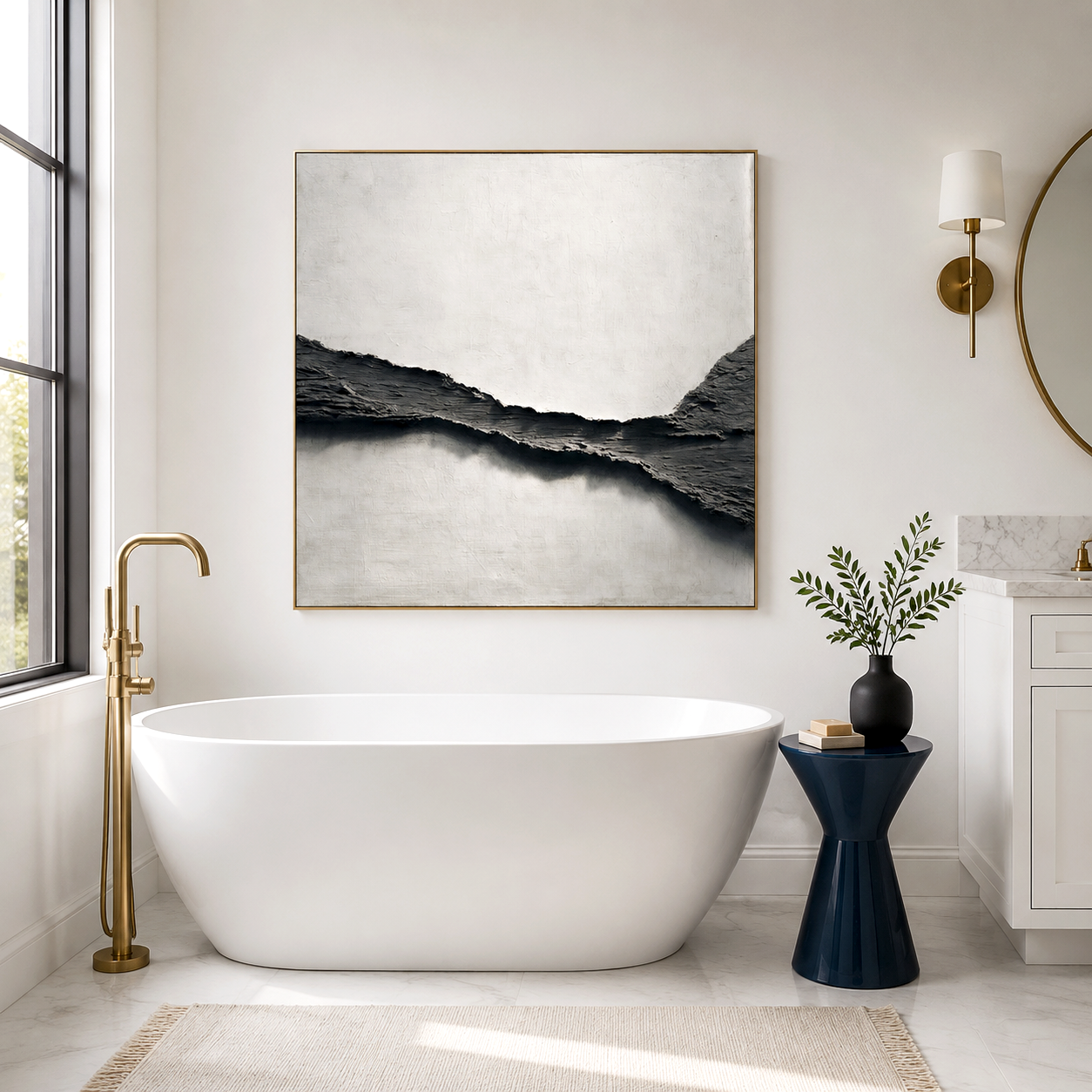
Every master bedroom faces a hidden design conflict: the space must look visually complete and sophisticated during the day, yet feel deeply restorative and quiet at night. Traditional high-contrast decor and standard framed gallery prints often fail this balance, inadvertently introducing sensory friction that disrupts sleep readiness. By looking at artwork through the dual lenses of room design and bedroom comfort, homeowners can transform the wall above the bed from a mere decorative surface into a functional, balancing architectural element.
Why Traditional Feature Walls Disrupted Bedroom Comfort
The conventional approach to a bedroom feature wall usually involves bold patterned wallpaper, high-contrast posters, or heavy glass-covered artwork. While these techniques succeed in creating immediate visual impact in a showroom or a living room, they break down in private spaces designed for rest.
The issue stems from a combination of modern building materials and standard interior lighting choices. Most contemporary bedrooms rely heavily on drywall, hardwood or laminate floors, and expansive glass windows. These materials are hard and acoustically reflective. When a large, hard-surfaced or glass-covered art piece is hung above the headboard, it creates a highly reactive environment. Faint ambient noises—such as the steady hum of an air conditioner, outdoor traffic, or simple physical movement—bounce off these surfaces, causing a micro-echo or flutter effect that keeps the human nervous system in a subtle state of alertness.
Furthermore, glass-covered frames pose a major challenge to evening lighting plans. When bedside lamps or warm reading lights are switched on, polished glass acts like a mirror, bouncing sharp glare points directly back toward the bed. Even if a homeowner does not consciously focus on these reflections while lying down, the human eye naturally catches sharp light transitions in a low-light room, which can delay the natural transition into a restful state.
The Science of an Acoustic Sleep Sanctuary
A more refined design strategy approaches the space directly above the headboard as a cohesive sensory system. The objective is not to soundproof the room in a industrial or commercial sense, but to achieve a noticeable reduction in visual and auditory sharpness.
Tactile, oversized canvas art in neutral palettes behaves completely differently than factory-printed posters or glass frames. The hand-applied texture introduces micro-shadows across the surface of the canvas. When evening light hits these dimensional ridges, the light is absorbed and diffused across a soft gradient, completely eliminating sharp glare and mirrored reflections.
From a spatial comfort perspective, a layered canvas structure acts as a mild acoustic dampener on an otherwise bare drywall surface. It helps soften the perception of room echo and lowers the crispness of high-frequency background sounds. When paired with secondary room elements like woven area rugs, thick linen curtains, and upholstered headboards, a large-scale textured canvas helps the entire bedroom wall visually and aurally recede, setting a calmer tone for sleep.
Choosing the Ideal Scale and Placement Above the Bed
Scale is the specific parameter where most master bedroom design choices fail. A small artwork hung above a massive king-size or queen-size headboard creates visual fragmentation, making the entire wall feel unfinished and casual. Conversely, multiple small frames hung together in a gallery wall layout can feel cluttered and busy in a space that requires structural simplicity.
For a king-size bed, a single substantial canvas or a balanced set of two matched vertical panels provides the most stable structural anchor. The artwork should span roughly two-thirds to three-quarters of the overall width of the headboard. This exact ratio ensures that the art looks intentional and proportionate without spilling past the boundaries of the bed itself.
When hanging the piece, it is crucial to align the visual midpoint of the artwork with the exact center of the headboard rather than the midpoint of the entire wall. Homeowners should leave a clear buffer of six to eight inches of breathing space between the top of the headboard and the bottom of the canvas. This prevents the arrangement from looking compressed while ensuring the canvas sits slightly above the direct line of sight of bedside lamps, creating soft shadow transitions that enhance the depth of the artwork's surface.
Evaluating Bedroom Artwork Materials and Frameworks
To make an informed decision for a premium interior, it is useful to look at how different artwork styles compare across the key functional categories that affect daily bedroom use.
| Artwork Category | Primary Spatial Benefit | Visual Reflection Control | Structural Safety and Weight |
| Acousart Handmade Collections | Softens room echo via layered, thick canvas structures and heavy hand-painted paint texture. | High; 100% matte oil finishes diffuse bedside lamp light into a soft glow. | High; lightweight wooden chassis with no dangerous glass components over the sleeping area. |
| Framed Mass-Market Prints | None; hard backing materials add to room reflectivity. | Low; glass or polished plastic covers create direct specular glare points at night. | Low; heavy outer frames and fragile glass panels pose a structural hazard over headboards. |
| DIY Mini Gallery Walls | Minimal; small surfaces do not provide enough contiguous area to affect acoustics. | Mixed; multiple frames create multiple fragmented glare points across the wall. | Medium; multiple mounting points increase installation complexity and drop risks. |
Integrating Textures into Diverse Master Suite Scenarios
Every interior design theme benefits from controlled texture and lower contrast above the headboard, though the specific execution varies depending on the style of the room.
-
Neutral and Minimalist Master Bedrooms: A completely bare wall can make a minimalist bedroom feel cold and unfinished. Introducing a large-scale, handmade neutral canvas in cream, sand, or soft taupe adds architectural dimension through its physical texture while preserving the clean, uncluttered look of the room.
-
Coastal and Serene Master Suites: Traditional coastal design often relies on high-contrast blue prints or literal ocean motifs that can feel predictable. A texture-led ocean abstraction focusing on soft horizon lines and low-contrast palettes brings the calming movement of water into the room without adding visual noise.
-
Wabi-Sabi or Soft-Luxe Spaces: These interiors rely heavily on organic transitions and imperfect, artisanal surfaces. A thick, hand-textured piece with natural variations blends seamlessly into the surrounding architecture, embracing quiet luxury by prioritizing material quality over loud patterns.
Supporting the Entire Wall with Coordinated Product Lines
A successful master bedroom layout often requires one primary visual anchor supported by one or two nearby decorative decisions rather than a single isolated piece. To help designers and homeowners coordinate a cohesive room layout without creating an overly matched, sterile showroom environment, Acousart organizes its catalog into distinct structural collections.
For large king-size walls needing a wide, stable baseline, the Acousart All Product Collection provides the most comprehensive starting point for scaling canvas sizes. When a modern master suite features hard interior angles and requires visual softening, the organic forms found within the Acousart Flower Collection introduce elegant curves that balance sharp architectural lines. For coastal homes or spaces aiming for maximal atmospheric calm, the layered depth of individual pieces like the Acousart Whispering Waves Textured Ocean Art allows the wall to act like a serene horizon, grounding the entire room's layout.
Frequently Asked Questions
What type of statement art works best above a master bedroom headboard?
Large-scale, matte-finish canvas art featuring low-contrast compositions works best. It provides proper visual proportion to the bed, avoids the distracting night-time glare associated with glass-framed art, and eliminates visual clutter.
Can acoustic wall art improve sleep quality by reducing room echo?
Textured, layered canvas art helps create a calmer, less reactive acoustic environment by softening reflected sound and dampening high-frequency flutter echoes. However, it does not soundproof a room from outside noise and should be viewed as an environmental comfort enhancement rather than a medical sleep aid.
Why should you avoid hanging glass-covered picture frames in a bedroom?
Glass acts as a mirror under evening bedside lighting, reflecting sharp glare points and physical movement back toward your eyes. This can subtly delay cognitive relaxation before sleep. Additionally, glass adds unnecessary weight and structural hazard when hung directly over a sleeping area.
Is one large artwork better than multiple smaller pieces above the bed?
Yes. A single large artwork or a tightly coordinated set of two matched panels creates a much more stable and anchored visual field. A collection of multiple small frames fragments the wall space, creating visual noise that fights the room's primary purpose as a rest environment.
How big should statement art be for a king-size bed?
The artwork should span approximately two-thirds to three-quarters of the total width of the headboard. This exact range ensures the piece looks balanced and architecturally integrated with the furniture below it.
How does Acousart fit modern bedroom wall art trends?
It aligns directly with the shift toward quiet luxury and tactile, artisanal home design. By focusing on 100% hand-painted oil surfaces and thick textures, it bridges the gap between traditional decorative artwork and functional, acoustic-conscious interior elements.