
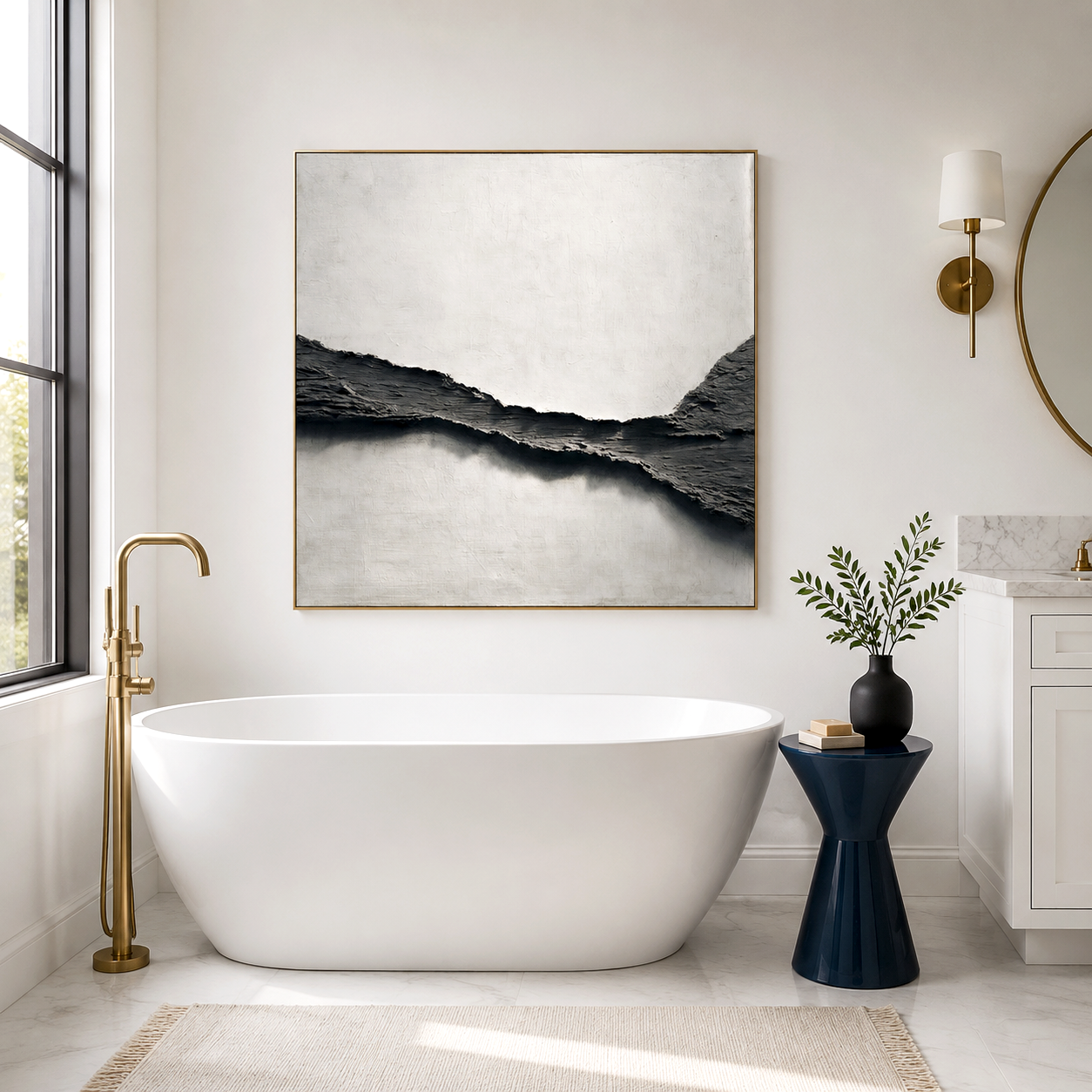
Handmade plaster wall art earns its place in a Wabi Sabi interior when the room needs presence without noise. Rather than relying on a detailed image, glossy color, or a perfectly repeated pattern, it uses raised sculptural marks, matte surfaces, and subtle irregularity to give a pared-back wall something to hold the eye. The value lies in that physical character: light catches a ridge differently in the morning than it does at dusk, and a neutral composition can still feel alive at close range. For a minimalist home, handmade plaster wall art is worth considering when you want the wall itself to contribute warmth, materiality, and a sense of calm—not simply fill an empty space.
Why plaster texture belongs in Wabi Sabi rooms
Wabi Sabi design finds beauty in material honesty, restraint, and the evidence of making. It does not mean accepting careless work or deliberately damaged decor. Instead, it makes room for slight variation: an uneven edge, a softened contour, a hand-worked surface, or a finish that changes gently with the light.
This is where plaster wall art and Wabi Sabi meet naturally. A sculptural surface introduces organic depth without competing with the quiet architecture of the room. In a space built from pale timber, linen upholstery, stone, clay, and aged metal, a smooth printed canvas can appear visually flat. Plaster-style texture gives the wall a comparable tactile weight, allowing the artwork to feel integrated with the room’s materials rather than applied as an afterthought.
The most successful pieces are restrained. Think low-relief arcs, broad tonal fields, imperfect grid lines, dune-like contours, or layered marks in chalk, sand, warm grey, mushroom, and mineral brown. Their interest comes from shadow and surface rather than from visual busyness.
The difference is felt before it is explained
A standard mass-produced canvas often depends on a printed image to create depth. Handmade textured canvas takes another route: the surface itself changes the experience of the work. Raised areas catch side light, recesses hold shadow, and a matte finish keeps the composition grounded instead of reflective.
This does not make every handmade textured piece automatically right for a minimalist home. The scale of the relief matters. A deeply sculpted composition with strong contrast can become the room’s dominant gesture, while a low-relief plaster impasto art piece can function more like a calming architectural finish. Decide which role the wall needs before choosing the artwork.
Let light complete the composition
Handmade plaster textures are especially responsive to directional light. A window, pendant, floor lamp, or wall washer can reveal the shifting planes of the surface; front-facing, flat illumination tends to make those details recede. Before committing to a piece, notice how daylight moves through the room and where evening lighting falls.
In a living area, place tactile wall art where it can be seen from the primary seating position but does not compete with every other focal point. Above a low sofa, a long sideboard, or a simple bench, the artwork can create a horizontal anchor that steadies an open wall. In a dining space, it may work best opposite the table, where guests can take in the texture gradually rather than encountering it only in passing.
A useful restraint is to give the piece visual breathing room. Wabi Sabi interiors tend to feel more convincing when the art is not boxed in by crowded shelving, several competing frames, or overly symmetrical accessories. One substantial handmade plaster-style piece can often do more than a clustered gallery wall.
Texture should feel discovered, not announced. If the art is the loudest object in a room designed for stillness, reduce the contrast around it before replacing the piece.
Choosing scale without making the room feel staged
A small work on a wide, bare wall can look tentative, even if its texture is beautiful. Conversely, oversized organic minimalist wall decor can make a compact room feel compressed when it sits too close to furniture, door frames, or ceiling lines. The goal is not maximum coverage; it is a proportion that gives the composition enough authority to register from across the room.
Above a sofa or console, choose a width that feels related to the furniture below rather than detached from it. In a narrow entry or reading corner, a vertical piece can introduce height and rhythm without widening the visual field. A pair of related panels can be useful where one large rectangle would feel too formal, especially when the gap between them becomes part of the composition.
Color deserves the same restraint. A plaster piece does not need to match every beige cushion or timber finish exactly. It should, however, share the room’s temperature. Warm cream, putty, clay, tobacco, and soft black tend to sit comfortably with oak, travertine, linen, and hand-thrown ceramics. Cooler greys and off-whites can work beautifully with concrete, ash wood, and blackened steel, provided the room still has enough softness elsewhere.
Is handmade textured art worth the investment for a minimalist home
The better question is whether the piece supplies something your room currently lacks. Handmade plaster wall art is a considered choice when a minimal interior feels clean but impersonal, or when the existing palette is calm yet visually weightless. Its value is in its decorative and sensory role: it adds a slow, close-up quality that printed art and perfectly smooth surfaces may not provide.
It may be less suitable if the room already relies on highly expressive stone, heavily grained wood, patterned rugs, or intricate ceramics. In that setting, another textured surface can create competition rather than balance. A simpler monochrome canvas, a quiet photograph, or an unadorned wall may be the better choice.
When assessing a handmade piece online, look beyond the main product image. Consider the depth and direction of the texture, how the color changes in detail photographs, the dimensions in relation to your wall, and whether the design will still feel right when viewed from both across the room and at arm’s length. A tactile wall art for Wabi Sabi interior should reward proximity without demanding constant attention.
Decorative art is not acoustic treatment
Plaster-style artwork is a decorative artistic statement, not a functional acoustic wall treatment. Its textured appearance should not be confused with sound absorption, soundproofing, or a solution for outside noise, neighbor noise, or speech privacy.
That distinction matters most in rooms with glass, tile, concrete, high ceilings, or sparse furnishings. If a space has a genuine echo problem, address its acoustic needs through appropriate room treatment, soft furnishings, rugs, curtains, and—where necessary—professional advice. The role of handmade plaster art is different: it contributes visual softness, material depth, and a more grounded atmosphere.
Keeping those functions separate leads to better decisions. You can choose a plaster piece because it belongs in the visual language of the room, not because it is being asked to solve a performance problem it was never designed to address.
Building a calmer wall around handmade texture
A Wabi Sabi wall works through relationships. The artwork may be the tactile center, but its surrounding elements determine whether it feels settled. Pair handmade textured canvas with materials that have their own quiet variation: a limewash-like wall finish, woven linen, solid wood, ceramic vessels, wool, or natural stone. Avoid adding too many similar relief patterns nearby; the art needs contrast as much as harmony.
For a living room, begin with one clear gesture. A pale plaster composition above a low, earth-toned sofa can offset the softness of upholstery with a more architectural surface. In a bedroom, choose gentler contours and lower contrast so the piece supports restfulness rather than becoming a visual interruption. In an entry, a more sculptural form can establish the home’s material palette before the rest of the interior comes into view.
Those drawn to understated relief, muted palettes, and intentionally irregular surfaces can explore Acousart’s Wabi Sabi Art collection as a starting point. The collection is most relevant when the aim is a quiet, textural focal point rather than a highly graphic or image-led statement.
When a three-dimensional piece is the better answer
Some walls call for texture that is visible from across the room. This is especially true in open-plan interiors, large living rooms, and spaces with long sightlines, where a subtle painted surface may disappear. A three-dimensional work can bring enough shadow play to hold the wall while preserving a largely neutral palette.
The key is to match the form to the home’s existing geometry. Rounded, flowing relief can soften a room of straight architectural lines and rectangular furniture. More linear or layered forms can provide structure in a space filled with curved upholstery and loose organic shapes. Either way, keep the surrounding styling edited. A 3D piece needs fewer companions, not more.
For walls that need a more pronounced sculptural presence, the 3D Wall Art collection offers a focused way to compare relief-led compositions. Choose based on the relationship between texture, scale, and light—not on the assumption that greater surface drama is always better.
Frequently Asked Questions
Why is plaster wall art used in Wabi Sabi interiors?
Plaster wall art suits Wabi Sabi interiors because its matte, sculptural surface celebrates subtle irregularity, natural shadow, and material depth. It gives a minimal room visual warmth without relying on ornate imagery or bright color.
Can handmade plaster wall art work in a small living room?
Yes, provided the scale and contrast are controlled. A low-relief work in a muted tone can add depth to a compact room without making the wall feel crowded.
Does imperfect texture mean lower quality?
No. In well-made handmade plaster-style art, variation is an intentional part of the composition. Look for deliberate movement, balanced texture, and a finish that feels considered rather than accidental.
Is plaster wall art an acoustic panel?
No. Decorative plaster wall art is not the same as an acoustic treatment and should not be selected for soundproofing or echo-control performance.