
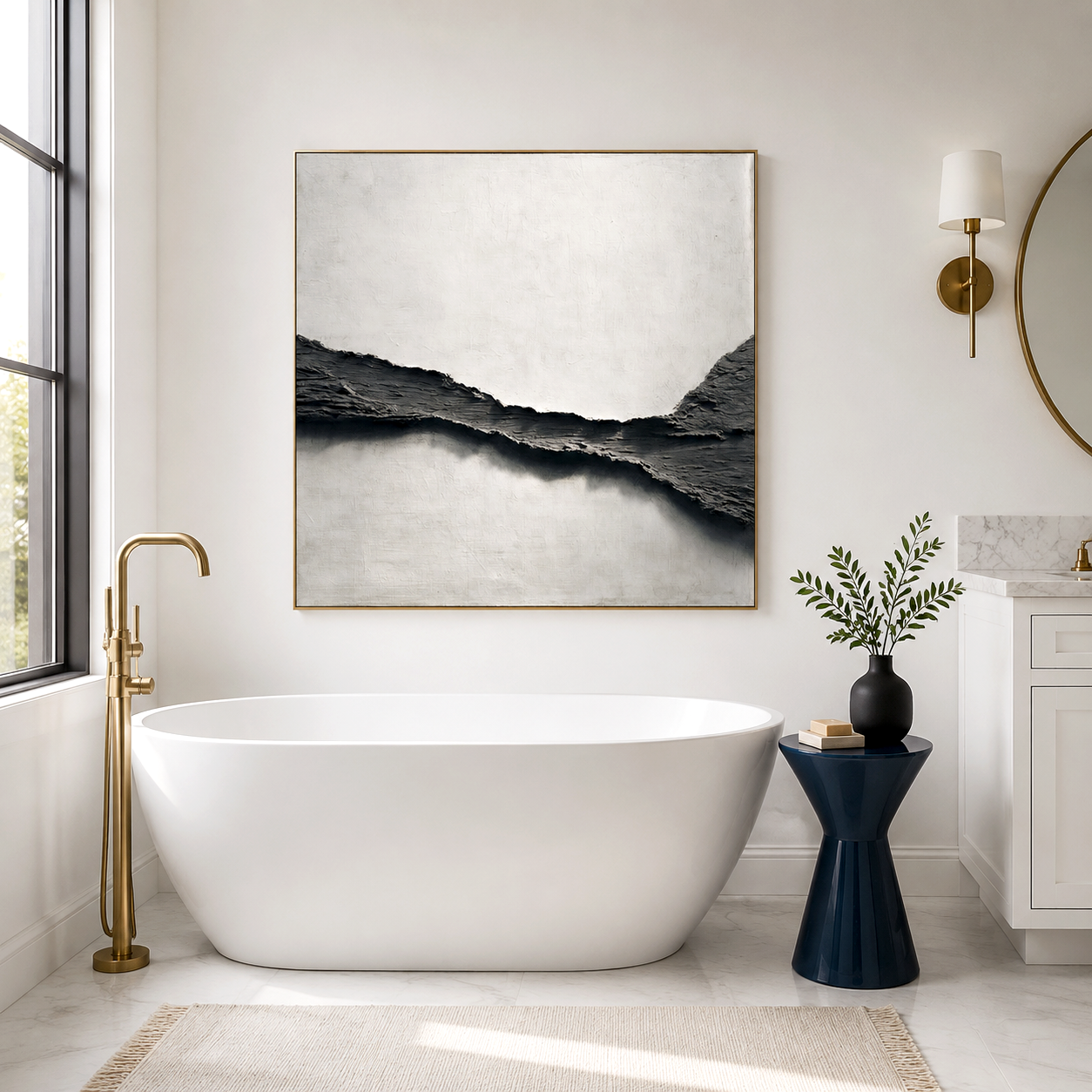
The conversation around art market evolution has quietly shifted away from prestige and resale narratives toward something more immediate and personal: how art contributes to daily living. In contemporary homes—especially those defined by open layouts, glass, concrete, and minimal finishes—art is no longer expected to sit passively on a wall. It is increasingly chosen for how it shapes atmosphere, softens visual and acoustic harshness, and reflects the identity of the people who live with it. This change does not reject beauty; it expands it. The value of art is being measured less by where it came from and more by what it does inside a space.
The rise of utilitarian beauty in modern interiors
A well-designed room today is expected to feel as considered as it looks. That expectation has influenced how art is selected. Instead of treating paintings as isolated focal points, designers and homeowners are integrating them into a broader sensory experience—one that includes light, texture, sound, and spatial flow.
Hard surfaces have become a defining feature of modern interiors. Stone flooring, expansive windows, and clean-lined walls create a refined visual language, but they also introduce echo and a certain acoustic sharpness. In these environments, art that carries physical depth or material presence does more than decorate. It helps balance the room, visually and perceptually.
This is where functional art enters the conversation. Not as a replacement for traditional artwork, but as an evolution of it. Pieces that incorporate texture, layered surfaces, or acoustic-aware construction can help a space feel calmer and more grounded without compromising design intent. For readers exploring this direction, collections like Explore our Frame + Acoustic Art collection illustrate how visual composition and atmospheric comfort can be considered together rather than separately.
From gallery walls to lived environments
Traditional gallery-driven art consumption often places emphasis on provenance, authorship, and display context. While those factors still matter in certain circles, they are less central to how many homeowners now approach art.
The shift is subtle but important. Art is no longer primarily acquired to be preserved; it is chosen to be lived with. That changes the criteria:
-
Does it suit the scale and proportion of the room?
-
Does it complement materials already present?
-
Does it contribute to a sense of calm, warmth, or focus?
These questions are grounded in use rather than status. A large abstract canvas in a double-height living room, for example, is not only a visual anchor—it can also reduce the sense of emptiness that often amplifies echo. Similarly, multi-panel works can distribute both visual weight and surface coverage across a long wall, making a space feel more cohesive.
This shift reflects a broader understanding of value: art is meaningful when it enhances how a space functions emotionally and sensorially.
Why custom commissions are becoming central again
One of the clearest signals in the future of the art market is the return of direct, personalized creation. Advances in digital communication and commissioning processes have made it easier for individuals to shape the outcome of a piece before it is made.
Custom art answers a question that pre-made works cannot always resolve: “Does this belong specifically in my space?” That sense of belonging comes from alignment—scale, palette, subject, and even the mood a piece carries.
In bespoke interior design projects, commissioned paintings are often used to bridge gaps that off-the-shelf art cannot fill. A homeowner might need a triptych that fits a precise wall width, or a textured piece that complements both a sofa fabric and a stone finish. In more personal contexts, artwork derived from meaningful imagery—such as family references or places—adds a layer of emotional relevance that gallery pieces rarely provide.
The result is not just decoration, but integration. Art becomes part of the architecture of the home rather than an addition to it.
When art begins to support acoustic comfort
It is important to be precise here: wall art does not soundproof a room. It will not block external noise or replace dedicated acoustic construction. However, in echo-prone interiors, certain types of art can help soften how sound behaves within the space.
Rooms with minimal furnishings and hard surfaces tend to reflect sound waves repeatedly. This creates a sense of harshness—voices feel sharper, conversations less comfortable, and the room itself less settled. Introducing surface variation, especially across larger wall areas, can help break up these reflections.
Textured or acoustically considered wall art works best when it is part of a broader approach. Placement matters. A single small piece on an isolated wall will have limited effect, while a thoughtfully scaled artwork positioned across a primary reflective surface can contribute to a more balanced acoustic feel.
A common misstep is treating decorative art as an afterthought in acoustically challenging rooms. When artwork is undersized or placed only for symmetry, it may look correct but do little to address the underlying harshness of the space.
The goal is not technical perfection but perceptual improvement. A room that feels quieter, softer, and more composed often owes that quality to a combination of elements—furnishings, textiles, and increasingly, the right kind of wall art.
A different way to think about value in art
The language of “investment art” has limited relevance for most homeowners shaping their living spaces. What matters more is how art contributes to the quality of everyday life.
Value, in this context, becomes multi-layered:
-
Visual coherence: how well the piece integrates with the room’s design language.
-
Emotional resonance: whether it feels personal, meaningful, or grounding.
-
Spatial impact: how it influences the perception of scale and proportion.
-
Atmospheric contribution: whether it helps the room feel calmer, warmer, or less acoustically sharp.
This framework does not diminish art—it brings it closer to lived experience. A painting that consistently improves how a room feels has a kind of durability that goes beyond trends or market cycles.
Where Acousart fits into this shift
As the boundaries between art and interior function continue to blur, certain formats naturally emerge as more relevant than others. Acoustic wall art, particularly when combined with handcrafted or textured finishes, sits at that intersection.
Acousart approaches this space by treating artwork not as a purely decorative layer, but as part of the room’s overall composition. The emphasis is on pieces that hold visual presence while also supporting a softer, less reflective environment. This makes them particularly suited to open-plan living areas, home offices, and hospitality-inspired interiors where both aesthetics and comfort matter.
For those seeking something more personal, commissioning a piece introduces another layer of alignment. Scale, palette, and subject can be tailored to the exact conditions of the space. Options like Commission your custom painting reflect how accessible this process has become, allowing homeowners to move beyond generic wall decor toward something more intentional.
The future of art in the home is experiential
What is unfolding is not a rejection of traditional art, but an expansion of its role. As homes become more curated and design-aware, art is expected to contribute to the full experience of a space—not just its appearance.
This means considering how a piece interacts with light throughout the day, how its texture changes the perception of a wall, and how its presence influences the way a room sounds and feels during everyday use. It also means acknowledging limits: no single artwork will solve every acoustic or spatial challenge, and in some cases, broader design adjustments are needed.
Still, the direction is clear. The future of art market evolution, at least within residential design, is less about ownership and more about integration. Art is becoming part of how a home functions—quietly shaping comfort, identity, and atmosphere in ways that are felt as much as they are seen.
Frequently Asked Questions
Is it better to buy art for investment or for my home?
For most homeowners, art is more valuable when chosen for how it enhances the living environment rather than for speculative purposes. A piece that improves how your space looks and feels offers daily, tangible value.
How does custom-commissioned art compare to the traditional art market?
Custom commissions prioritize personal fit—size, color, mood, and context—while traditional markets often emphasize authorship and provenance. For residential interiors, commissioned work often integrates more naturally into the space.