
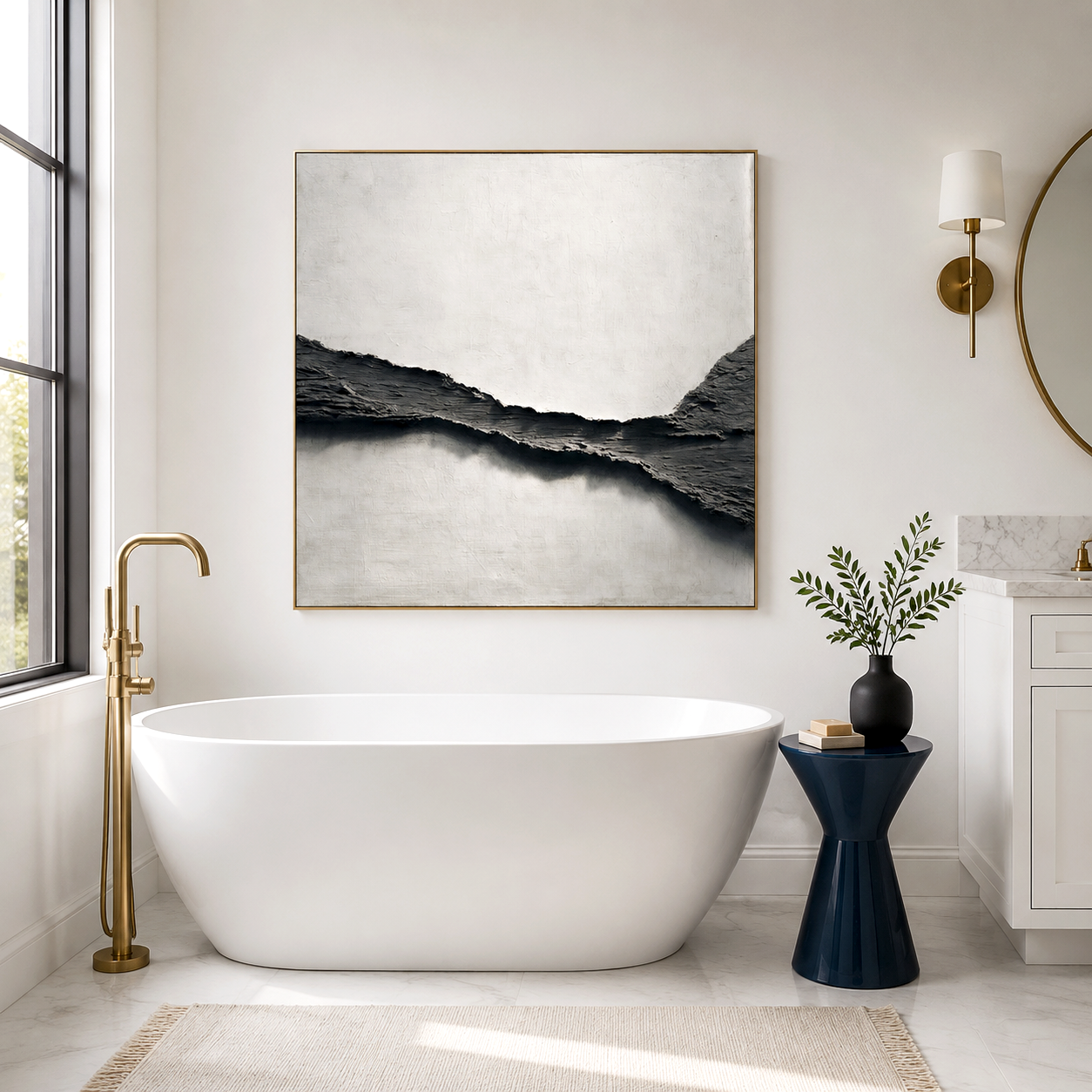
Made-to-order textured wall art solves a very specific design problem: the wall is too important to fill with a generic print, but too awkward in scale or proportion to leave bare. With custom sizing and hand-crafted texture, the artwork can be shaped around the room instead of forcing the room to adapt to the artwork. That matters in homes with wide living-room walls, dining areas that need a stronger focal point, and open-plan spaces where one small piece can disappear visually. The appeal is not just that it looks different; it is that it can be made to fit the architecture, the palette, and the mood of the room more precisely than standard ready-made decor.
Why custom sizing changes the whole wall
Standard prints often fail because the wall is not standard. A sofa wall may be long and low, a stair landing may be vertical and narrow, and an open-plan dining zone may need a piece that reads from across the room without overwhelming the table below it. Made-to-order textured wall art gives you control over width, height, and proportion, which is often the difference between a piece that feels considered and one that feels like a placeholder.
That flexibility is especially useful on oversized walls, where small art can look accidental, and on difficult architectural surfaces, where the wrong scale can make the room feel top-heavy or empty. When the dimensions are tailored to the space, the artwork can do a better job of anchoring furniture, balancing ceiling height, and creating a clear focal point. If you are comparing options, browse 3D textured art collection to see how dimensional surfaces can change the way a wall reads even before color or subject comes into play.
Texture is not decoration alone
The most persuasive difference between custom textured wall art and a flat print is physical depth. Hand-crafted mediums such as impasto-inspired surfaces or plaster-style finishes introduce visible variation in brushwork, ridges, and shadow, which gives the piece a presence that changes throughout the day as the light moves. In a bright room, that depth can make the artwork feel alive; in a softer room, it can create quiet complexity without needing a busy subject.
This is where bespoke canvas paintings and hand-painted custom art panels stand apart from mass-produced wall decor. A flat print repeats the same surface from edge to edge, while a textured piece carries small irregularities that make it feel more singular and more closely tied to the idea of an original interior statement. For buyers who want made-to-order modern art that looks intentional rather than assembled from a catalog, texture is often the deciding factor.
How to scale art for real rooms
Measuring for large scale bespoke wall decor is less about choosing the biggest option and more about choosing the right relationship between artwork, furniture, and negative space. A useful first step is to look at the wall in context: measure the usable width, note the height of nearby furnishings, and decide whether the artwork should act as a quiet anchor or the main visual event. In living rooms, the piece often works best when it sits in dialogue with the sofa rather than floating far above it. In dining spaces, it should feel centered to the table and visible from the room’s entrance. In open-plan areas, scale matters even more because the art has to hold its own from multiple sightlines.
A simple way to avoid undersizing is to think in terms of proportion rather than decoration. A small canvas on a broad wall can make the wall feel unfinished, while an oversized piece can crowd the room if the surrounding furniture is low or compact. The most successful custom pieces usually feel inevitable, as if the wall was waiting for that exact width and height.
A common mistake is choosing artwork before measuring the wall. Once the room is mapped properly, the “right” size often becomes obvious, and the design decision gets much easier.
Matching texture to the color palette
Custom textured wall art works best when it supports the room’s existing palette instead of competing with it. In a neutral interior, layered whites, stone tones, taupe, and muted greys can let the surface texture do most of the work. In a richer room, deeper earth tones, charcoal, or softened color fields can help the piece feel integrated rather than pasted onto the wall. The goal is not perfect color matching; it is visual balance.
This is also where handmade surfaces can be more forgiving than highly polished imagery. Texture can bridge slight differences between wall color, upholstery, flooring, and accessories because the eye reads depth and tone together. If the room already has strong patterns, a quieter surface may be the better choice. If the room is visually calm, a more tactile piece can add enough character to prevent the space from feeling flat.
When custom art is the better choice
Made-to-order textured wall art is usually the right direction when the wall has a specific job to do. That includes large living rooms that need a focal point, dining rooms that need a more finished backdrop, entryways that should feel complete immediately, and open-plan interiors that need one visual anchor to organize the rest of the layout. It also suits buyers who want the art to reflect the architecture more precisely, rather than settling for a nearby size that is “close enough.”
By contrast, a ready-made piece can be the better answer when you need something quickly, want to decorate a smaller wall, or are still experimenting with the room’s overall direction. Custom work asks for a little more planning, but the payoff is clarity: the piece fits the wall, the finish fits the room, and the result feels intentional. For readers who want to move from idea to selection, explore all wall art products after you have measured the wall and settled on the scale that makes sense.
What to expect before ordering
Custom wall art is most satisfying when the buyer understands what is being customized. Size, proportion, texture, subject, and finish all matter, but they do not all solve the same problem. A larger piece changes visual balance; a more tactile surface changes presence; a carefully chosen palette changes how the room feels; and a made-to-order format ties those choices together. If you are trying to fill a difficult wall, that combination is often more useful than a standard print in a standard frame.
It is also worth being clear about what this kind of art is not. Decorative textured wall art is not the same as acoustic treatment, and it should not be chosen for soundproofing claims or assumed room-performance results. Its strength is visual and spatial: it can help a room feel more finished, more dimensional, and more tailored to the architecture. That is a different value, and for many interiors, it is the one that matters most.
Frequently Asked Questions
Why choose made-to-order textured art instead of mass-produced canvas prints? Made-to-order art allows exact customization of dimensions to fit your specific wall space while offering authentic hand-crafted textures and brushwork.
How long does it take for custom textured wall art to be created? Production time varies based on the complexity of the hand-painted medium and drying requirements for heavy textures or plaster-style finishes.