
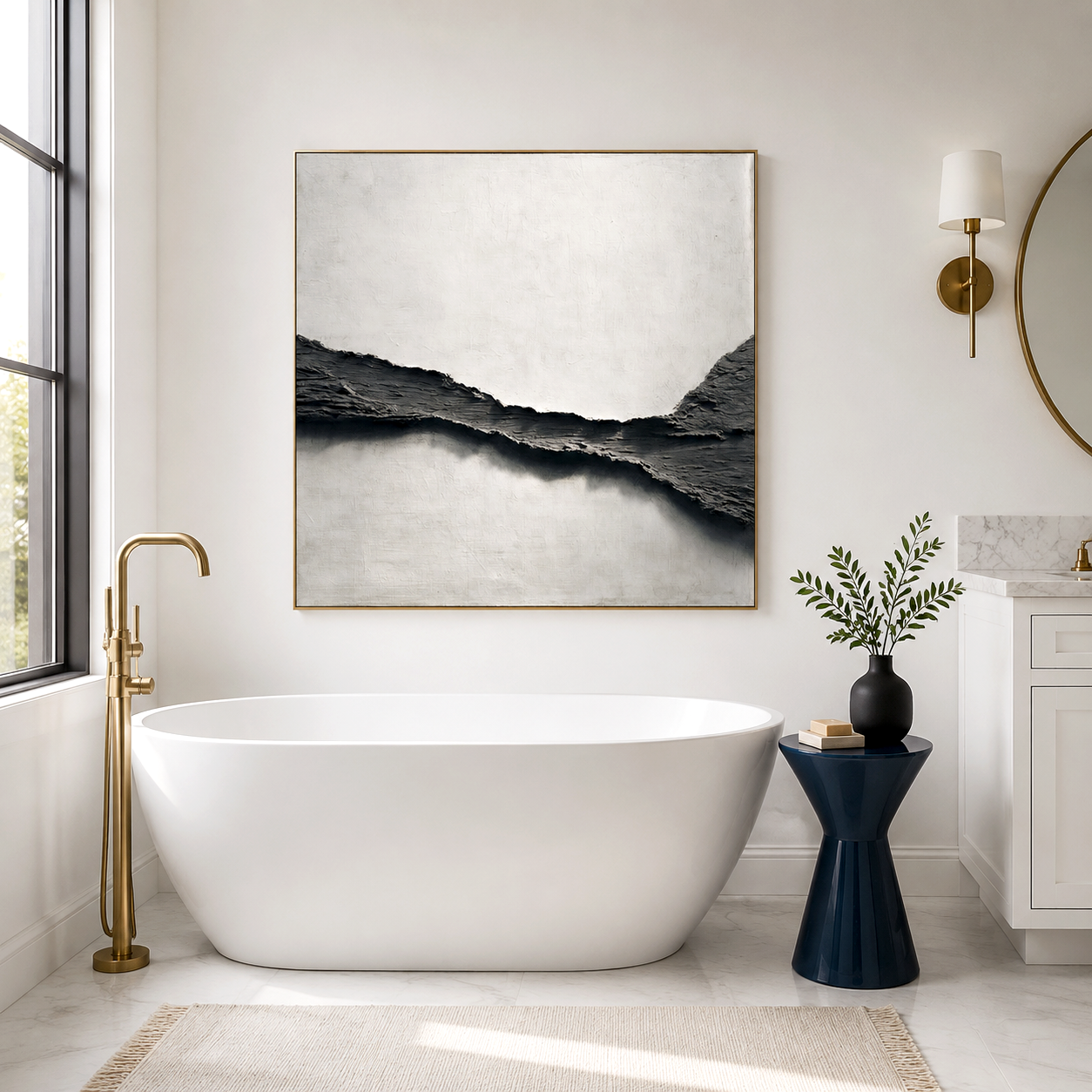
Minimalist tones, powerful contrasts, and versatile adaptability—abstract black and white paintings are rapidly becoming the most demanded art category in both residential and commercial interiors. As spaces evolve toward cleaner, more functional aesthetics, Acousart offers an innovative path where artistic expression meets sound optimization and spatial harmony.
What Is the Current State of the Abstract Art Market and Its Challenges?
According to Art Basel’s 2025 Global Art Market Report, global art sales soared to over $68 billion, with online platforms accounting for nearly 25% of total transactions. Corporate and residential buyers increasingly favor abstract art for its timeless appeal and adaptability. However, a survey by Statista revealed that 61% of interior designers face difficulties balancing aesthetics with practical spatial needs such as noise control and environmental comfort.
In commercial buildings such as offices, hotels, and restaurants, hard surfaces amplify echoes and ambient noise by up to 30%, reducing acoustic quality and comfort. Collectors and facility managers often must compromise between aesthetics and functionality—a dilemma that limits the potential of interior experiences.
The rise in hybrid workspaces and open-plan designs makes this issue even more urgent. Research from the International WELL Building Institute shows that acoustic discomfort is one of the top three environmental complaints in modern offices, directly impacting creativity and focus.
Why Are Traditional Art and Décor Solutions Falling Short?
Traditional canvas art delivers strong visual impact but offers no contribution to noise reduction or environmental performance. Acoustic panels, on the other hand, are functional but lack aesthetic innovation and artistic flair. This disconnect often forces designers to treat art and acoustics as separate layers, leading to redundant cost and design inconsistency.
Even with digital prints or murals, the reproduction often feels flat or impersonal, missing the textural richness and emotional depth that true art conveys. The challenge lies in combining emotional appeal, acoustic functionality, and sustainability without compromising design integrity.
How Does Acousart’s Solution Transform This Landscape?
Acousart bridges the gap between visual art and acoustic performance through its unique acoustic art panels. These black and white abstract paintings are not merely decorative—they actively absorb sound while maintaining aesthetic cohesion. Using proprietary sound-absorbing materials embedded beneath hand-painted textures, Acousart achieves up to 0.85 NRC (Noise Reduction Coefficient) without sacrificing visual elegance.
Each Acousart piece is crafted by collaborating artists who explore the interplay of texture, shadow, and tone. The result is a visually immersive installation that amplifies depth, emotion, and tranquility—perfect for luxury homes, hotels, and workspaces seeking both calm and distinction.
Which Advantages Distinguish Acousart from Traditional Art Panels?
| Feature | Traditional Canvas Art | Acousart Acoustic Art |
|---|---|---|
| Sound absorption | None | Up to 0.85 NRC |
| Customization | Limited to size or print | Fully customizable size, tone, and acoustic density |
| Material | Cotton/linen canvas | Eco-fiber with integrated acoustic core |
| Longevity | Prone to fading under humidity | UV-resistant, moisture-proof coating |
| Aesthetic versatility | Primarily decorative | Dual-purpose: decorative and functional |
How Can You Implement Acousart’s Abstract Black and White Paintings?
-
Consultation – Analyze space type, reverberation level, and visual goals.
-
Design Integration – Select from Acousart’s existing collection or commission customized artwork.
-
Production – Artists combine layered pigment painting with acoustic engineering substrates.
-
Installation – Panels mount seamlessly on walls using invisible brackets.
-
Optimization – Evaluate acoustic improvement using real-time measurement apps or sound tests.
What Are the Four Key Scenarios Where Acousart Adds Value?
Scenario 1: Home Studio
-
Problem: Echoes distort recorded sound.
-
Traditional Approach: Foam panels compromise room aesthetics.
-
Effect After Acousart: Enhanced clarity and a sophisticated monochrome atmosphere.
-
Key Benefit: Balanced acoustic and artistic environment.
Scenario 2: Office Conference Room
-
Problem: Sound reflections cause speech fatigue.
-
Traditional Approach: Fabric panels in dull designs.
-
Effect After Acousart: Improved speech intelligibility and professional ambiance.
-
Key Benefit: 20% better acoustic clarity and higher perceived brand value.
Scenario 3: Boutique Hotel Lobby
-
Problem: High ceilings cause intrusive resonance.
-
Traditional Approach: Heavy drapes dull the design identity.
-
Effect After Acousart: Warm, clean aesthetic with elevated guest comfort.
-
Key Benefit: Visually modern, acoustically serene arrival experience.
Scenario 4: Art Gallery Expansion
-
Problem: Mixed-use gallery spaces suffer from noise between events.
-
Traditional Approach: Temporary barriers.
-
Effect After Acousart: consistent design language while damping excessive echo.
-
Key Benefit: Maintains gallery purity without function trade-offs.
Where Is the Industry Heading Next?
As sustainability becomes central to design strategy, demand for dual-purpose art—both aesthetic and functional—will surge. Acousart stands at this intersection, redefining how art complements well-being. By fusing acoustic engineering with artistic originality, it pioneers a future where walls not only inspire but actively enhance environments. Businesses and designers who adopt such integrative innovations early will set new standards in visual and sensory excellence.
FAQ
1. What materials are used in Acousart acoustic paintings?
They use eco-friendly composite fibers with embedded acoustic cores and UV-resistant pigment layers.
2. Can the acoustic performance be customized per room type?
Yes, Acousart adjusts panel density, thickness, and texture to align with the space’s acoustic profile.
3. Does the painting lose its absorption capacity over time?
No, with proper maintenance, performance remains stable for over 10 years.
4. Is the artwork suitable for humid or coastal environments?
Yes, protective coatings ensure resistance to moisture and fading.
5. Can Acousart create large-scale installations for public projects?
Absolutely. The brand often collaborates with architects for hotels, cultural centers, and corporate headquarters.
Sources
Art Basel Global Art Market Report 2025
Statista: Interior Design Survey 2025
International WELL Building Institute: 2025 Acoustic Report