
A glass-walled boardroom can look impeccable and still sound unforgiving. Long tables, polished stone, and metal hardware reflect speech back into the room, so voices blur during video calls and client discussions. Corporate art solutions are increasingly expected to solve both sides of that problem: present a refined visual identity and help tame the echo that undermines clarity. The most effective approach is not adding more technology, but choosing wall art that quietly contributes to acoustic comfort while holding its own as executive-grade decor.
Why premium offices often sound worse than they look
The materials that signal “high-end” in corporate interiors—glass partitions, concrete cores, lacquered cabinetry—are also highly reflective to sound. When multiple hard surfaces face each other, speech energy bounces between them, creating flutter echo and a subtle ringing tail that muddies consonants.
In practice, this shows up as repeated requests to “repeat that,” fatigue during long meetings, and inconsistent audio quality on calls. Even a well-specified AV system cannot compensate for a reflective envelope. The room itself needs softening at the right surfaces to reduce those reflections.
Moving beyond industrial panels to design-led acoustic decor
Traditional fixes rely on fabric-wrapped boards or foam tiles. They work functionally, but they telegraph a call-center aesthetic that clashes with executive environments. For procurement teams and designers, the compromise is obvious: improved sound at the cost of visual authority.
A newer category of corporate art solutions reframes the choice. Instead of exposing acoustic treatment, it is embedded behind or within a finished artwork—often a hand-painted or textured canvas—so the room reads as a gallery rather than a technical installation. The effect is subtle: fewer harsh reflections, a calmer acoustic feel, and no visible “equipment” on the walls.
Where acoustic art makes the biggest difference in a boardroom
Placement matters more than quantity. Mounting art randomly along a feature wall looks complete but may miss the reflections that actually disrupt speech.
A reliable strategy is to address the first reflection paths between speakers and listeners. In many boardrooms, that means the wall opposite the main display and sections of side walls that mirror the table’s long axis. Treating these surfaces helps intercept early reflections before they return to the listener’s ear.
In a typical 10–14 seat conference room with a large screen on one end, mounting textured acoustic canvases on the wall directly opposite the display often reduces the “slap” you hear when someone speaks from the far end of the table. The improvement is not silence, but clearer speech edges and less fatigue over time.
Ceiling treatments and rugs can contribute, but wall-mounted pieces are often the least disruptive way to improve conditions without altering architecture.
The boardroom audio visual integration checklist
Use this as a quick specification guide when aligning art with AV performance:
-
Identify reflective surfaces facing the main display and along the table’s length; prioritize these walls for acoustic art placement.
-
Size artwork to meaningfully cover reflection zones; a single small piece rarely changes perception in a large, hard-surfaced room.
-
Choose textured or layered canvases that introduce surface irregularity; this supports scattering and absorption rather than mirror-like reflection.
-
Coordinate frame finishes with hardware; black or brushed silver frames anchor neutral canvases against glass and steel.
-
Keep sightlines clean around cameras and displays; avoid glare-prone finishes opposite screens.
-
Balance symmetry for visual authority with strategic asymmetry where reflections are strongest.
Matching aesthetic language to corporate identity
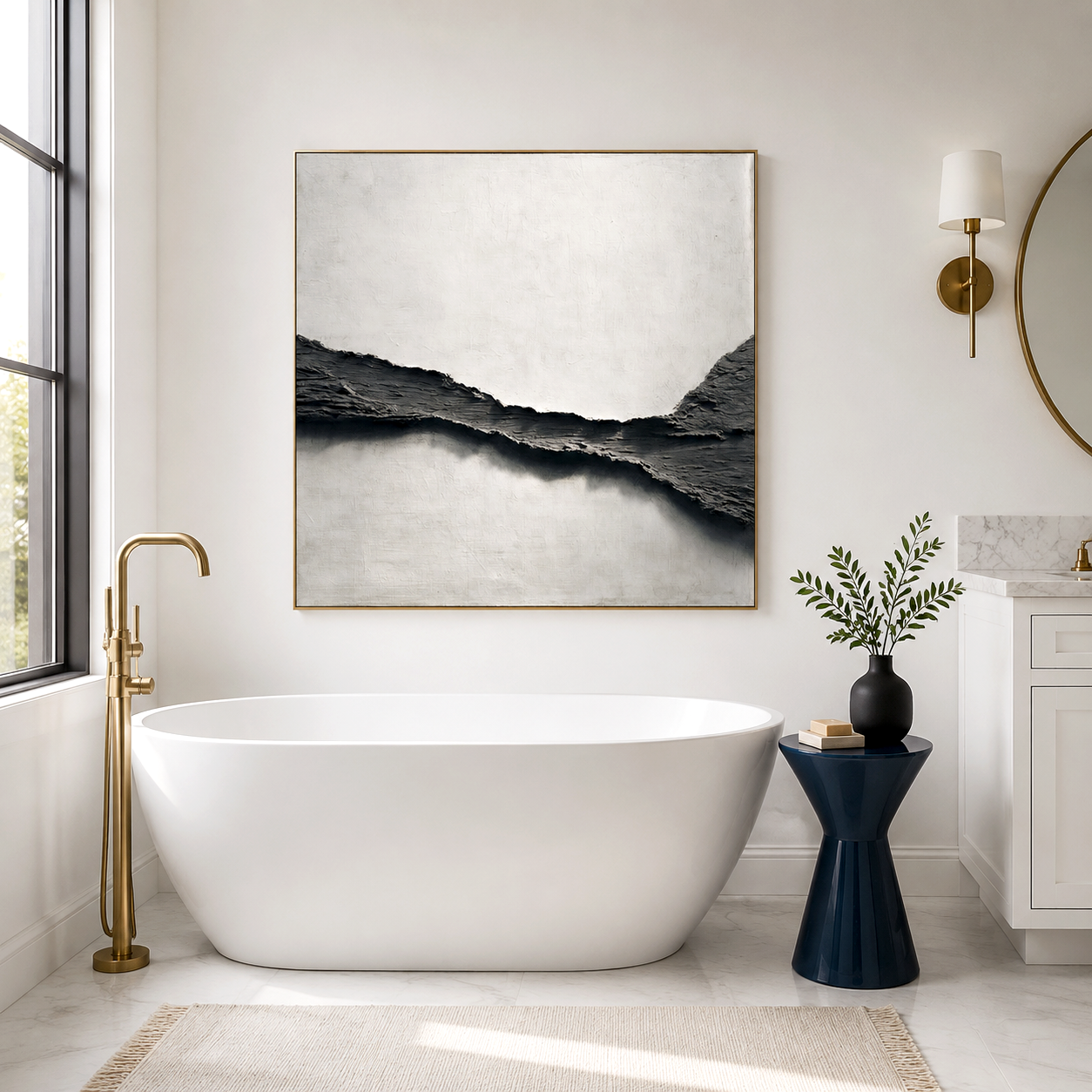
Executive spaces demand restraint. Minimalist neutral textured wall art works because it carries depth without visual noise. Subtle tonal shifts, hand-applied texture, and controlled compositions read as intentional at close range and calm from across the room.
Frame choice becomes a technical as well as aesthetic decision. A slim black frame can ground pale canvases against darker glazing, while a silver or brushed metal frame can echo hardware finishes in a glass-and-steel environment. Multi-panel sets are useful on long walls, allowing you to scale coverage without introducing a single oversized focal point that competes with the display.
What these solutions can and cannot do
Acoustic art improves the feel of a room by softening reflections; it does not soundproof it. External noise from corridors or adjacent offices will still pass through walls and glazing. Likewise, a single canvas will not correct a large, highly reflective space.
Think in terms of contribution rather than cure. When combined with thoughtful placement, appropriate sizing, and complementary elements like carpeting or upholstered seating, acoustic art can noticeably improve speech clarity and reduce perceived harshness. For mission-critical spaces, a broader acoustic plan may still be required.
Specifying for procurement and trade teams
Corporate projects introduce practical requirements that residential decor rarely addresses: consistent sizing across rooms, durable frames, repeatable finishes, and a clear path for bulk ordering and invoicing. This is where design-led acoustic solutions need to meet procurement reality.
Acousart positions its work in that overlap—hand-painted, gallery-grade canvases with integrated acoustic cores designed for echo-prone interiors. For teams managing multiple rooms or a phased rollout, their professional corporate trade program provides a structured path to specify, standardize, and scale without defaulting to industrial panels.
Choosing pieces that support both image and clarity
When selecting for a boardroom, prioritize pieces that read as intentional backdrops on camera and as tactile artworks in person. Neutral palettes reduce glare and visual distraction during calls, while textured surfaces help break up reflections. On longer walls, consider a coordinated set that distributes coverage; on feature walls, a single large canvas can anchor the room if it is sized to the reflection zone rather than just the wall.
If you want a starting point, explore a restrained palette such as minimalist neutral textured wall art, then adapt scale and framing to your room’s geometry and hardware.
Frequently Asked Questions
How do you reduce echo in a glass-walled corporate boardroom beautifully?
Use acoustic wall art placed on reflection paths—especially the wall opposite the main display and along the table’s length—so it softens early reflections while presenting a refined, gallery-like surface.
What type of wall art is recommended for high-end executive offices?
Minimalist, neutral, textured canvases with controlled compositions are preferred. They maintain visual authority, avoid glare on camera, and can support acoustic comfort when designed with absorptive layers.
Where should art be mounted relative to the video screen?
Mounting art on the wall opposite the screen is often effective because it intercepts reflections traveling between speakers and listeners. Side walls that mirror the table also benefit from coverage.
Is acoustic art enough to fix poor meeting audio?
It helps but is not a complete fix. It reduces perceived harshness and improves clarity, but external noise and major reverberation issues may require additional acoustic measures.
Where can corporate interior designers source commercial-grade acoustic art solutions?
Look for suppliers that combine art quality with scalable trade support—consistent sizing, durable frames, and bulk procurement options—so the solution fits both design intent and project logistics.