
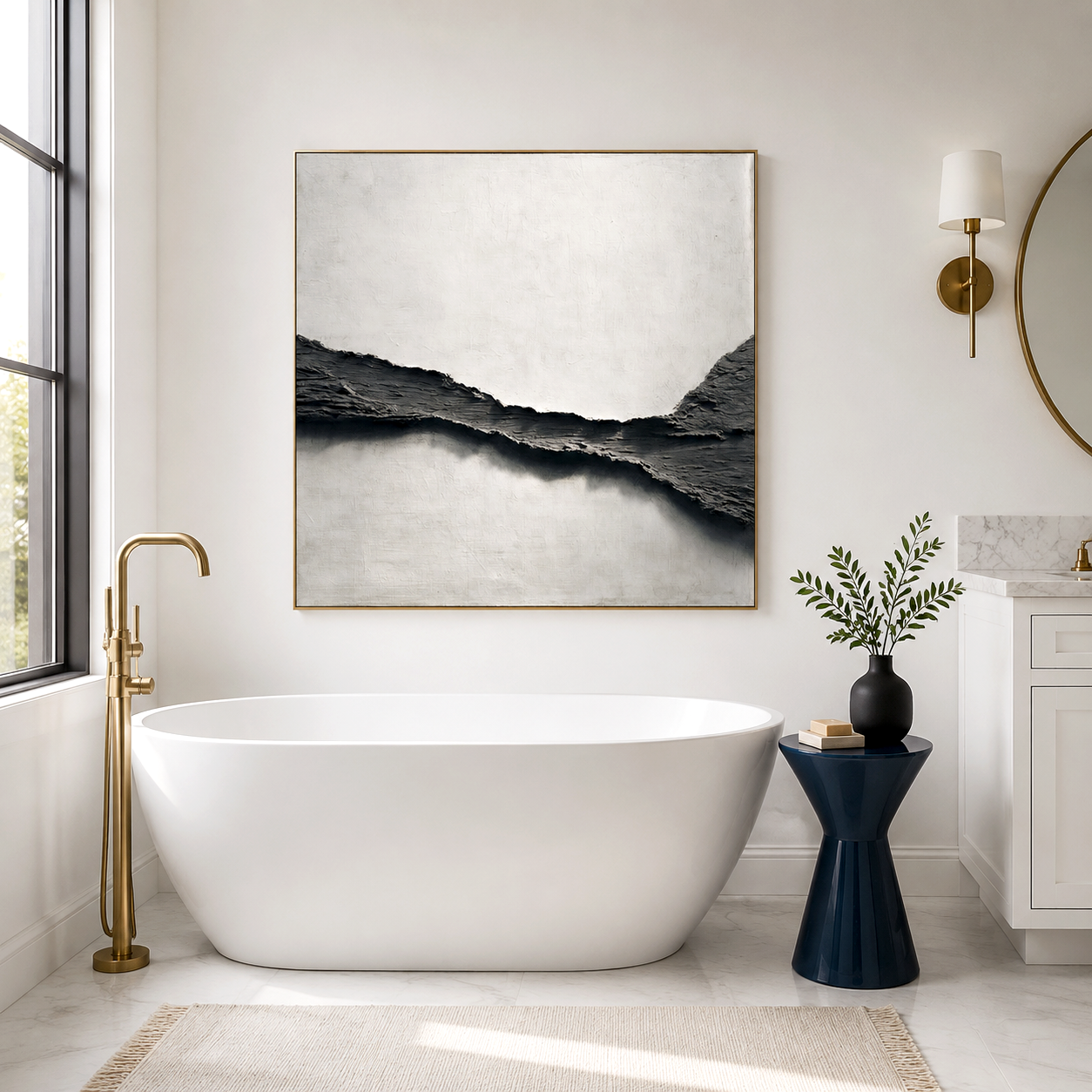
A room with crown molding, paneling, or traditional trim often feels complete on its own—until you introduce modern furniture and the walls suddenly become the problem. Transitional style art exists to resolve that tension. It should neither echo old-world portraiture nor compete with bold contemporary graphics. The most effective solution tends to be large-scale, neutral abstract work with visible texture: it respects the depth and craftsmanship of traditional interiors while keeping the visual language clean enough for modern living. When chosen carefully, this kind of art does more than decorate—it stabilizes the entire room.
Why transitional rooms often feel visually unresolved
The challenge isn’t the furniture. It’s the contrast between architectural detail and surface treatment.
Traditional interiors carry weight. Wainscoting casts shadows, crown molding creates layered edges, and older layouts often emphasize symmetry. When modern furniture enters—low-profile sofas, simplified silhouettes—it reduces visual density. If the wall art doesn’t respond correctly, the room splits into two competing eras.
Flat prints tend to disappear against detailed walls. Highly modern art, especially with sharp contrast or digital precision, can feel disconnected from the craftsmanship of the space. Transitional style art needs to act as a mediator, not a statement that pulls the room in a new direction.
The anatomy of a transitional art piece
To consistently work in transitional interiors, art needs specific physical and visual characteristics—not just a vague “neutral” palette.
-
Surface depth: Thick paint, raised textures, or layered brushwork that visually echoes traditional oil painting.
-
Controlled palette: Creams, taupes, soft greys, charcoal, or muted earth tones that don’t compete with architectural detailing.
-
Abstract structure: Minimal or non-figurative composition that avoids historical references or overly modern symbolism.
-
Scaled presence: Large enough to hold its own against paneling or molding without needing excessive framing.
-
Soft contrast: Gradual tonal transitions instead of sharp color blocking.
This combination allows the artwork to feel grounded in the room rather than applied on top of it.
Texture is what bridges two eras
Texture is often the missing piece in transitional design discussions. It is what allows abstract art to feel appropriate in a traditional setting.
A heavily textured canvas carries shadows and depth similar to classical oil paintings, even when the subject is entirely abstract. This matters because traditional architecture already plays with light and shadow. When art reflects that same dimensionality, it integrates instead of floating.
By contrast, a flat print—even in neutral tones—can look visually thin next to deep molding profiles. That imbalance is subtle but noticeable, especially in formal living rooms or dining areas.
Brands like Acousart approach this balance through hand-applied textures and layered surfaces, offering pieces that feel substantial without reverting to traditional imagery. The result is artwork that visually “belongs” in the space while still reading as contemporary.
Placement decisions that shape the whole room
Where and how you place transitional style art affects both proportion and visual balance.
A single large canvas works best when you want to simplify the wall and anchor the room. For example, placing a square or slightly rectangular piece above wainscoting creates a clear visual hierarchy: architecture below, modern expression above.
A split composition—such as a set of two—works better in longer walls or when symmetry matters. This is especially effective in dining rooms where seating arrangements already establish balance.
Here is how common layouts behave in transitional spaces:
The key is not to fight the architecture but to complete it.
Can abstract art really work with crown molding
It not only works—it often works better than traditional imagery in updated interiors.
A common mistake is choosing “safe” landscape paintings to match traditional architecture, only to find the room feels dated again once modern furniture is added.
Abstract art avoids this trap because it removes historical reference points. Instead of reinforcing a past era, it allows architectural details to stand on their own while the furniture defines the present.
The success depends on restraint. Aggressive colors or overly sharp compositions can clash with the softness of traditional detailing. Neutral abstract textured wall art, however, complements rather than competes.
Where many buyers go wrong
The most frequent issue is underestimating scale and material presence.
Small pieces get lost above paneling. Thin canvases lack authority next to deep trim. Overly intricate art competes with the architecture rather than supporting it.
Another common mistake is treating wall art as an afterthought. In transitional interiors, it plays a structural role. It is not just decoration—it is the visual connector between two design languages.
Finding pieces that actually fit the transitional brief
If you are searching for options that align with these principles, it helps to start within collections designed around contemporary abstraction rather than traditional subject matter. Browsing a curated contemporary wall art collection makes it easier to identify pieces with the right balance of restraint, texture, and scale.
For rooms that need a particularly calm and cohesive look—especially those with cream-toned molding or neutral upholstery—works built around layered whites, soft greys, and charcoal strokes tend to integrate seamlessly. One example is neutral abstract textured wall art, where the depth of the surface does much of the visual work without relying on bold color.
These kinds of pieces are especially effective in dining rooms and formal living spaces where both elegance and simplicity need to coexist.
Transitional style art and acoustic comfort
While the primary goal is visual cohesion, textured canvas art can also subtly influence how a room feels acoustically.
Hard surfaces like wood paneling, plaster, and large dining tables reflect sound easily, which can make conversations feel sharper or slightly echo-prone. Textured wall art introduces a softer surface variation that can help reduce that sense of harshness.
It is not soundproofing, and it will not replace dedicated acoustic treatment. But in combination with rugs, upholstery, and curtains, it contributes to a more balanced, comfortable atmosphere—especially in rooms designed for gathering.
Frequently Asked Questions
What kind of art fits a transitional living room style?
Large-scale abstract art in neutral tones works best. It avoids historical references while still respecting traditional architecture through texture and material presence.
Can you hang abstract art in a house with traditional crown molding?
Yes, and it is often the most effective choice. The key is to choose abstract work with soft contrast and visible texture so it complements rather than clashes with the detailing.
How does textured canvas art help unify classic and modern decor?
The texture echoes the depth of traditional oil paintings, while the abstract composition keeps the overall look contemporary. This combination allows both styles to coexist without visual conflict.
Should transitional wall art be framed or unframed?
It depends on the room. Thick, gallery-wrapped canvases often work well unframed because they already have presence. In more formal spaces, a minimal frame can reinforce structure without making the piece feel traditional.
Is one large artwork better than multiple smaller pieces?
In most transitional interiors, one large piece creates a cleaner, more cohesive look. Multiple pieces can work, but they need careful spacing and alignment to avoid visual clutter.