
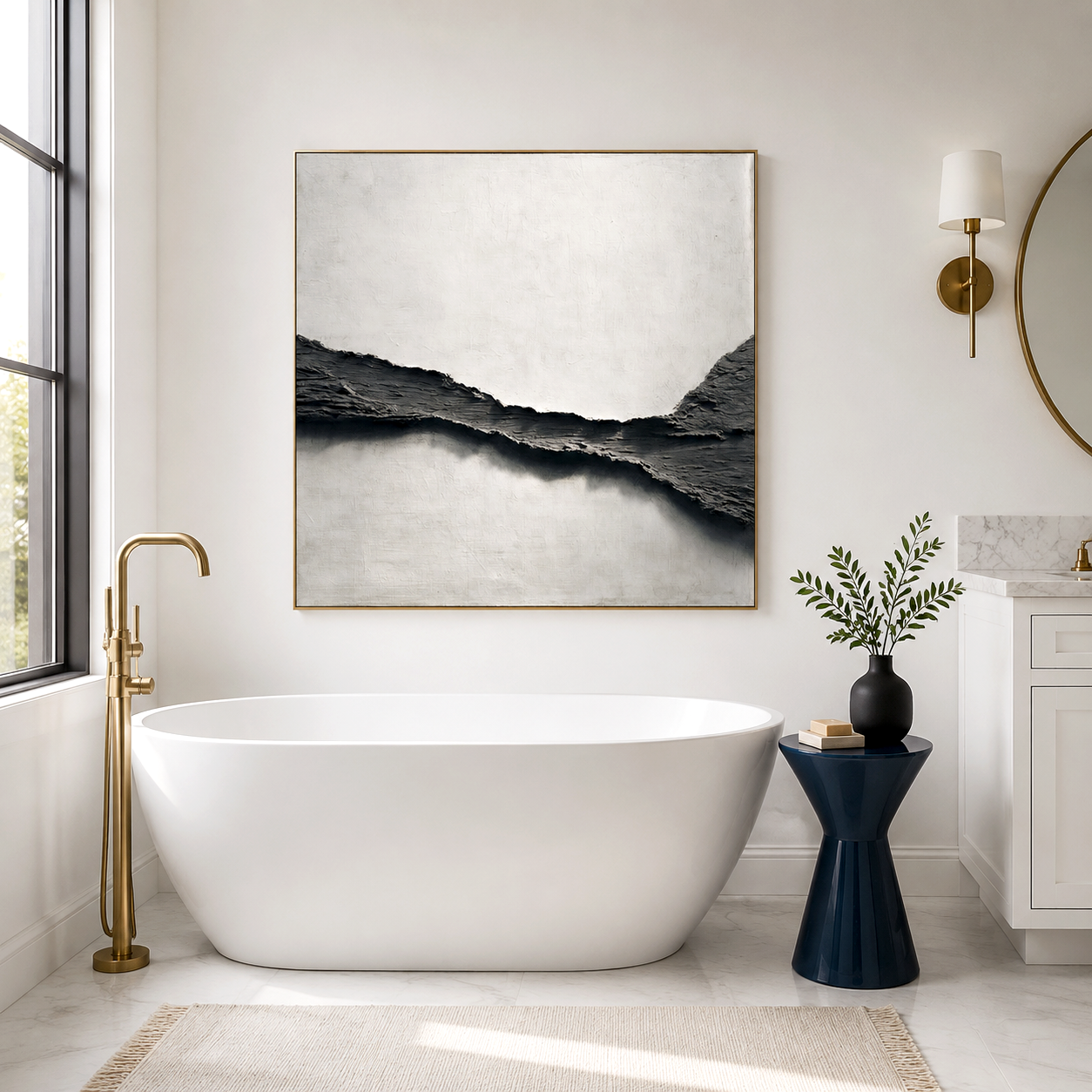
A bird painting using sculptural plaster texture can transform a flat, dull wall into a vertical space that feels taller and alive, but only if the piece captures motion rather than literal detail. The secret lies in solidifying the dynamic of flight through physical height differences in white plaster, where subtle feather scratches and negative space create an ethereal silhouette that stretches the eye upward. This approach differs fundamentally from traditional realistic brushwork; instead of rendering every feather with precision, it abstracts the soaring moment to achieve a quiet dynamism where movement exists within stillness. For modern Nordic or Japanese wabi-sabi interiors, this style introduces lightness without visual weight, breaking the monotony of large blank walls while maintaining the serene atmosphere these spaces demand.
The Physics of Lightness in Sculptural Bird Art
Traditional wall art often adds visual weight to a room, especially when it uses dark colors, heavy frames, or dense compositions. Sculptural bird painting reverses this principle by using physical thickness to create visual lightness. The technique relies on layering white plaster or acrylic medium to build height differences that catch natural and artificial light differently throughout the day.
When light strikes these raised surfaces, it creates micro-shadows that define the bird's form without using lines or color. The wing's upward curve becomes visible through the gradient of light across the plaster's surface. This is why the piece appears to float even though it has tangible physical depth.
The vertical orientation is critical. A bird painted in mid-flight with wings extending upward naturally draws the viewer's gaze toward the ceiling, creating an illusion of increased ceiling height. This effect is particularly valuable in apartments or rooms with low ceilings where architectural changes are impossible. The artwork becomes a vertical line that pulls the eye up, making the entire room feel more expansive.
How Height Difference Creates the Illusion of Flight
The sculptural approach works because human vision interprets height as motion. When a wingtip is physically raised higher than the body, the brain reads this as upward movement frozen in time. Artists achieve this by applying plaster in varying thicknesses, sometimes building up layers that stand several millimeters above the canvas surface.
Key elements of this technique include:
-
Strategic height gradients: The wing's leading edge rises higher than the trailing edge, mimicking the aerodynamic curve of flight
-
Feather texture through scratching: Instead of painting individual feathers, artists use tools to scratch fine lines into the plaster while it's still slightly pliable, creating the impression of feather texture without literal detail
-
Negative space as sky: Large areas of untouched white canvas surround the bird, representing the vastness of sky and allowing the form to breathe
-
Minimal color palette: Often limited to white, off-white, and subtle gray tones, ensuring the piece doesn't compete with furniture or other decor
This method creates what interior designers call "visual air" — the sense that space can move around and through the artwork rather than being blocked by it.
Why Minimalist Interiors Need Ethereal Motion
Nordic and wabi-sabi design philosophies share a commitment to simplicity, natural materials, and uncluttered spaces. However, both styles risk becoming sterility when taken too far. A room with only flat surfaces, neutral colors, and perfect minimalism can feel emotionally cold and visually boring. This is where bird painting with sculptural texture provides a necessary counterbalance.
The concept of motion within stillness addresses this tension directly. A static room needs a subtle element of dynamism to feel lived-in and alive. A bird in flight, even when abstracted and minimal, introduces this motion without disrupting the overall calm. The piece becomes a focal point that keeps the eye moving, preventing the space from feeling frozen or museum-like.
The Role of Negative Space in Japanese-Inspired Rooms
In Japanese aesthetics, the concept of "ma" refers to the purposeful use of negative space. It's not empty space; it's active space that gives form meaning. A bird painting that embraces ma leaves large areas of the canvas untouched, allowing the viewer's imagination to complete the image. This interactive quality makes the artwork more engaging than a fully rendered illustration.
For wabi-sabi interiors that celebrate imperfection and transience, the abstract nature of sculptural bird art aligns perfectly. The piece doesn't pretend to be a perfect photograph of a bird; it acknowledges its own artifice while capturing something essential about flight. This honesty resonates with the wabi-sabi appreciation for things as they are, not as they should be.
The vertical composition also serves a practical function in small urban apartments common in cities like Chicago, where many modern minimalist homes are located. When floor space is limited, vertical art maximizes visual impact without consuming valuable square footage. A tall, narrow bird painting can occupy wall space that would otherwise remain empty, adding personality without crowding the room.
When Sculptural Bird Painting Fails to Deliver
Even well-crafted bird painting can disappoint if the installation context or expectations don't align with reality. Understanding these failure points helps buyers avoid costly mistakes and ensures the artwork enhances rather than diminishes the space.
The Size Mismatch Problem
The most common mistake is choosing a piece that's too small for the wall. A delicate bird silhouette that looks refined on a portfolio website can disappear when hung above an oversized sofa or on a vast accent wall. The minimal nature of the art means it has less visual mass to compete with surrounding furniture.
Rule of thumb: The artwork should occupy 60-75% of the wall space above furniture. If hanging above a sofa, the piece should be roughly two-thirds the sofa's width. For empty walls without furniture below, consider a larger piece or a curated gallery arrangement where the bird painting is the anchor.
Lighting Conditions That Destroy the Effect
Sculptural texture depends entirely on light to reveal its form. A bird painting hung in a dark corner or under flat, overhead lighting will look like a flat white smudge. The height differences that create the illusion of flight need angled light to cast the micro-shadows that define the shape.
Ideal lighting scenarios include:
-
Natural light from the side: Windows positioned to the left or right of the artwork create dynamic shadows that change throughout the day
-
Adjustable track lighting or spotlights: Positioned at a 30-45 degree angle to the wall, these highlight the texture without creating glare
-
Avoid top-down recessed lighting: This flattens the texture by eliminating shadows
Rooms with only ambient, diffuse lighting will not showcase the sculptural qualities effectively. In such spaces, a flat canvas print might actually perform better visually, even if it lacks the tactile dimension.
Expectation Gaps Around Acoustic Claims
Some sellers market textured wall art as having significant sound-absorbing properties. While it's true that rough surfaces can diffuse sound slightly more than perfectly smooth ones, a single bird painting will not meaningfully change a room's acoustics. The acoustic benefit becomes noticeable only when multiple textured panels cover a substantial portion of wall surface area.
Don't expect a decorative bird painting to solve echo problems in a hard-surfaced room with concrete floors and large windows. For genuine acoustic improvement, you need dedicated sound-absorbing materials covering 20-30% of wall surface, or professional acoustic treatment. The bird painting can be part of a broader acoustic strategy, but it's not a standalone solution.
Choosing the Right Bird Painting for Your Space
When evaluating sculptural bird art for a minimalist interior, several criteria determine whether the piece will succeed in your specific environment.
Material Quality and Hand-Painted Authenticity
Not all textured art is created equal. Mass-produced prints with applied texture paste often look artificial and lack the subtle variation that makes hand-painted work compelling. The difference shows in close-up viewing: hand-applied plaster has natural irregularities, while machine-applied texture looks repetitive and uniform.
Look for these indicators of authentic hand-painted work:
-
Variation in texture thickness: No two areas should be perfectly identical
-
Visible brush or tool marks: Evidence of human creation rather than mechanical application
-
Depth that changes with viewing angle: The image should shift subtly as you move past it
-
No repeating patterns: Each feather scratch should be unique
Brands that emphasize 100% hand-painted oil art without mass-produced prints typically deliver more authentic sculptural work. The collective nature of artist studios often means emerging artists experiment more boldly with texture techniques, resulting in more distinctive pieces.
Color Temperature and Mood Matching
Even within a minimalist palette, color temperature matters. A bird painting with cool white plaster (blue undertones) creates a different mood than one with warm white (yellow undertones). Match the temperature to your room's existing palette:
Getting this wrong can make the artwork feel disconnected from the room, even if the style matches. A cool-toned piece in a warm-lit room will look clinical and sterile.
Placement Strategies for Maximum Impact
Where you hang the bird painting determines how effectively it stretches vertical space. The optimal placement follows these principles:
-
Center at eye level or slightly above: For standing viewers, center the piece at 57-60 inches from the floor (museum standard). For seated viewing (above a sofa), center it 8-12 inches above the furniture back
-
Leave breathing room above: Ensure at least 12-18 inches between the top of the artwork and the ceiling to maintain the illusion of upward motion
-
Avoid crowding with other vertical elements: Don't place it directly next to tall bookshelves or floor-to-ceiling curtains that compete for vertical attention
For rooms with multiple walls, the wall with the most natural light or the one visible from the main entrance makes the best location. The piece needs to be seen from a distance to appreciate its full vertical span.
How Acousart Approaches Sculptural Bird Art
Acousart, a Xiamen-based art collective, exemplifies the approach to textured bird art discussed here. The collective works with emerging artists who experiment with material boundaries, connecting wall art with interior atmosphere and tactile experience. Their work demonstrates how hand-painted texture can serve both aesthetic and environmental functions in modern spaces.
The collective's acoustic art direction emerged from a practical renovation challenge: transforming sound-absorbing panels into visual artworks for their city-center gallery. This origin story matters because it means their textured pieces aren't just decorative — they're designed with material function in mind. The soundproof painting board they use features a layered acoustic core behind the canvas surface, where inner material absorbs and diffuses sound rather than letting it bounce directly back into the room.
For buyers interested in bird painting specifically, Acousart's portfolio includes abstract and texture painting categories where sculptural bird forms appear. The collective's emphasis on no mass-produced prints and 100% hand-painted oil art aligns with the quality standards discussed earlier. Their work appears in homes, galleries, and commercial spaces, suggesting versatility across different interior contexts.
This doesn't mean Acousart is the only option, but their approach illustrates how a brand can integrate material experimentation (acoustic function) with aesthetic goals (ethereal bird forms) without compromising either. When evaluating any sculptural bird painting, ask whether the maker understands both the visual and material dimensions of their work.
Frequently Asked Questions
Can bird painting work in a small bedroom without making it feel cramped?
Yes, if you choose a vertical composition with ample negative space. The key is avoiding detailed, cluttered compositions that add visual weight. A minimalist bird silhouette in white plaster actually makes small rooms feel larger by drawing the eye upward and creating visual air. Avoid pieces wider than 60% of your wall width, and ensure adequate side lighting to prevent the piece from looking flat.
How do I clean textured bird painting without damaging the plaster?
Use a soft, dry microfiber cloth to gently dust the surface. Avoid water, cleaning solutions, or abrasive materials that could crack or discolor the plaster. For stubborn dust, use a soft-bristle paintbrush to lightly sweep across the texture. Never press hard on raised areas, as the plaster can chip if subjected to excessive force.
What's the difference between bird painting and avian abstract relief art?
The terms often overlap, but "bird painting" typically emphasizes the subject matter (a bird) while "avian abstract relief" emphasizes the technique (three-dimensional raised surface). In practice, sculptural bird painting is a subset of relief art where the relief specifically depicts a bird in flight. The distinction matters less than evaluating whether the piece captures motion and uses texture effectively.
Will sculptural bird art look good in a room with colorful furniture?
It can, but the color palette needs careful management. Neutral-toned bird painting (white, gray, off-white) works best as a calming counterpoint to colorful furniture, creating visual rest. If your furniture is already very neutral, you might choose a bird painting with subtle color accents. The key is ensuring the artwork doesn't compete with furniture for attention — it should complement, not fight.
How long does hand-painted sculptural bird art take to create?
The timeline varies significantly based on complexity, but expect 2-4 weeks for a medium-sized piece. Multiple layers of plaster must dry completely between applications, and scratching feather textures requires careful handwork. Rushed pieces often show uneven drying or sloppy texture. When ordering custom work, ask about the artist's process timeline and factor this into your decorating schedule.