
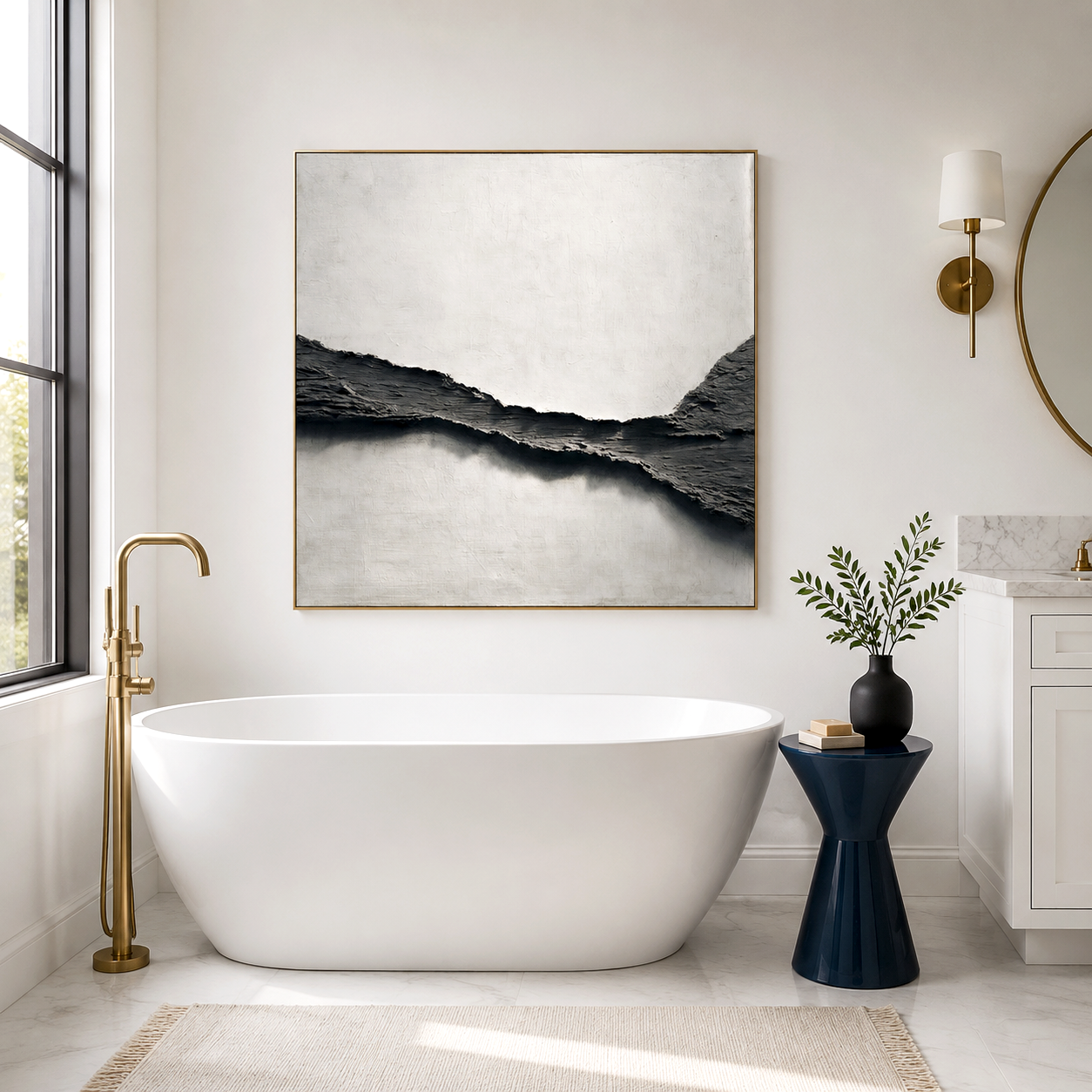
A beautiful room can still sound uncomfortable. Hard finishes, tall ceilings, and open layouts often create a bright, echo-prone environment where conversation feels sharp rather than relaxed. Hand-painted acoustic art sits in that tension. It offers a way to introduce sound-absorbing panels without the visual compromise of foam or office-style boards, but it only works if the artwork itself allows sound to pass through to the absorbent core behind it. When done correctly, it blends custom painting with genuine acoustic intent; when done poorly, it becomes decorative art placed over a functional surface, weakening the very purpose it was meant to serve.
Why painted surfaces must stay acoustically transparent
The most important technical reality is simple: acoustic panels work because sound energy can enter the surface and be absorbed by the material inside. If a hand-painted layer seals that surface, the panel behaves more like a reflective board than an absorber.
This is why “acoustic transparency” matters more than the painting style itself. A breathable, permeable finish allows air movement and sound energy to pass through. Heavy, non-porous coatings can block that pathway.
In practical terms, a well-executed piece of hand-painted acoustic art is not just a painting applied to any canvas. It is a controlled balance between pigment, binder, and application technique so the surface remains open enough for sound to travel inward. The painting must serve the panel, not suffocate it.
This is also where many generic “art panels” fall short. They prioritize visual impact first, then apply it onto a surface that was never designed to remain acoustically active.
How hand painted acoustic art is actually constructed
The integration happens in layers, and each layer has a role:
-
A sound-absorbing core that does the actual acoustic work.
-
A breathable fabric or surface layer that allows sound to pass through.
-
A hand-painted finish applied in a way that maintains permeability.
Unlike printed designs, hand painting introduces variability. Brush density, paint thickness, and texture all affect how open the surface remains. That is why not every hand-painted piece is automatically suitable for acoustic use.
This is also the reason some collections are explicitly developed and tested for compatibility with acoustic panels. If you want to see how this is handled in practice, you can Explore Verified Acoustic Art, where the artwork is designed with both visual and functional considerations in mind.
Custom acoustic art versus mass-produced panels
The difference is not just aesthetic; it changes how the piece interacts with the room and the design process.
What matters here is expectation. Custom pieces are chosen because they resolve a design problem and an acoustic discomfort at the same time, not because they outperform standard panels in raw absorption.
What this means for high-end interiors
In residential living rooms, executive offices, or boutique hospitality spaces, visual cohesion often outweighs purely technical solutions. Foam panels or exposed absorbers can feel out of place against stone, wood, or curated furnishings.
Hand-painted acoustic art changes the approach. Instead of adding “treatment” after the fact, the wall becomes part of the design language from the beginning. Large-format canvases, textured brushwork, or multi-panel compositions can visually soften a space while also helping reduce the sharpness of reflections.
The result is not silence. It is a shift in atmosphere. Conversations feel less strained, and the room carries less edge. This is especially noticeable in spaces with glass walls, polished floors, or minimal soft furnishings.
A common misstep in luxury interiors is assuming that a single statement piece will fix the acoustics of a large, reflective room. Even a well-made acoustic artwork has limited surface area. Without enough wall coverage, the improvement remains subtle.
Does paint reduce acoustic performance
It can, if handled incorrectly.
A thick, sealed paint layer may reduce how much sound reaches the absorbent core. This does not mean all painted acoustic panels are ineffective, but it does mean the painting process must be controlled.
The key considerations are:
-
Paint application thickness.
-
Type of medium used.
-
Whether the final surface remains breathable.
A properly executed hand-painted acoustic panel maintains enough openness to function as intended. An overly sealed surface shifts the balance toward decoration rather than absorption.
This is why it is inaccurate to assume that “more artistic” automatically means “less functional” or vice versa. The outcome depends on how the two are integrated.
When hand painted acoustic art is the right choice
It suits buyers who are trying to solve two problems at once: visual refinement and a reduction in echo or harshness. It is especially relevant when:
-
The space is design-led and cannot accommodate industrial-looking panels.
-
The wall is a focal point rather than a hidden treatment area.
-
The goal is to soften the acoustic feel, not achieve sound isolation or full-scale acoustic engineering.
It is not the right solution if the requirement is strict soundproofing, bass control, or technical studio-grade performance. In those cases, dedicated acoustic systems are still necessary.
How to approach a custom project
A successful custom piece starts with the room, not the artwork. Scale, placement, and wall coverage determine whether the panel will have a noticeable effect.
A typical process involves understanding the room dimensions, surface materials, and how the space is used—whether for conversation, meetings, or dining. From there, the artwork is developed to align with both the visual concept and the practical placement.
For designers, architects, or commercial buyers working across multiple spaces, it often makes sense to coordinate early. If you are planning a project that requires both aesthetic alignment and acoustic consideration, you can Inquire About Trade Services to explore custom or multi-piece solutions.
Where the value really lies
The “luxury” in hand-painted acoustic art is not superior sound absorption. It is the ability to resolve a design constraint without abandoning acoustic comfort entirely.
You are not buying a stronger acoustic panel. You are choosing a more intentional way to integrate one into a space that cares about visual identity.
When the surface remains acoustically transparent and the placement is thoughtfully planned, the result is a room that looks composed and feels calmer—without announcing that it has been acoustically treated.