
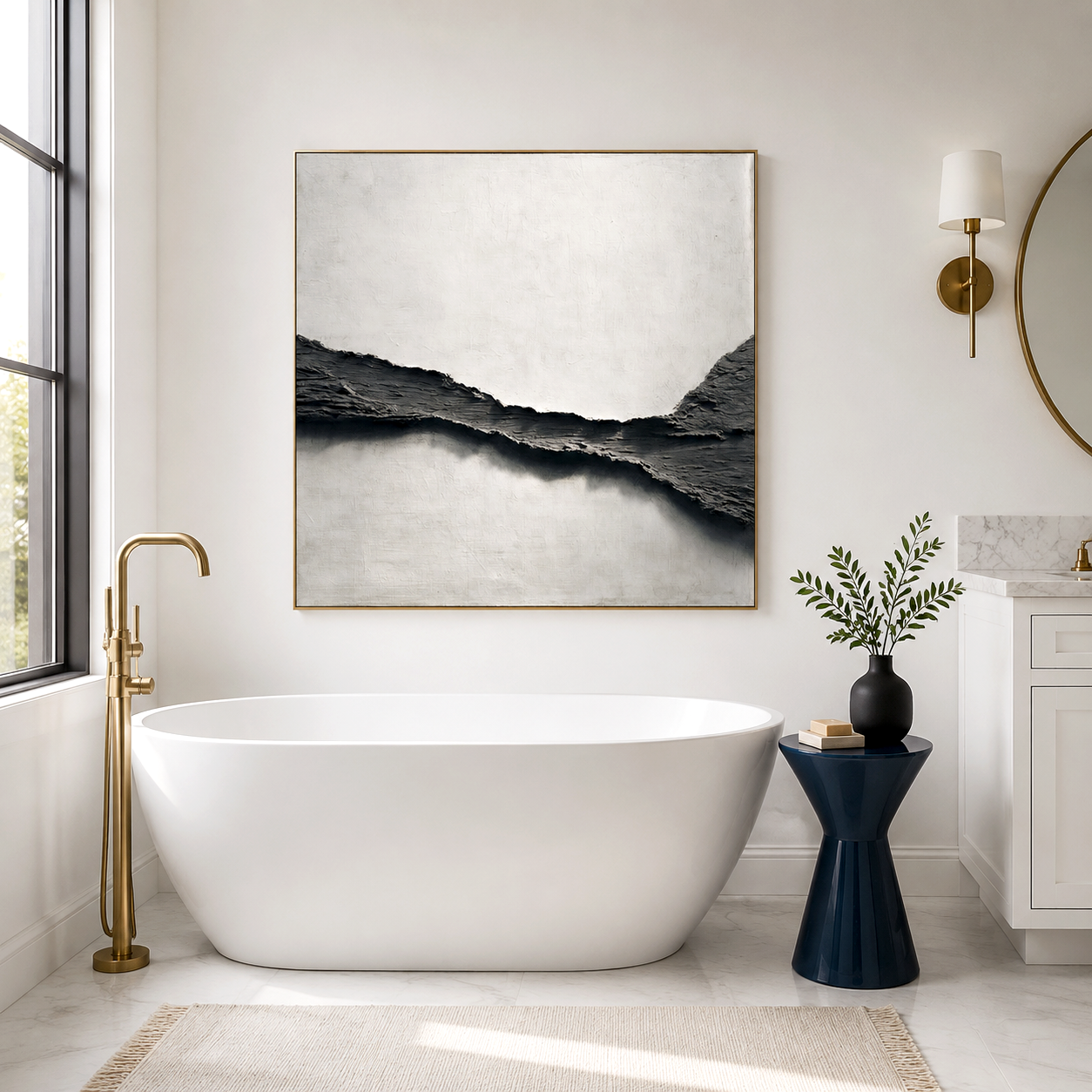
A lot of people arrive at acoustic art panels after a familiar frustration: the room looks finished, but it sounds sharp, echoey, or tiring to sit in. So do acoustic art panels work? Yes—but only when they are designed and used for sound absorption. Most decorative wall art, including textured canvas or oil paintings, does not meaningfully reduce echo. The difference comes down to how sound behaves in a room and whether the artwork is built to absorb reflections rather than simply reflect them back into the space.
Understanding that distinction is what separates a satisfying improvement from a purely visual upgrade.
Why ordinary wall art does not fix echo
A painted canvas, even a thick or textured one, behaves much more like a flat wall than people expect. When sound waves hit it, they mostly bounce back into the room instead of being absorbed.
This is why adding several large paintings to a minimalist living room often changes the look but not the sound. The materials used in standard wall decor—canvas stretched over a frame, paint layers, or plaster-like finishes—are not designed to trap or dissipate sound energy. They lack the internal structure needed to reduce reflections.
The result is subtle but important: voices still feel sharp, conversations overlap more easily, and the room retains that “live” acoustic character. This is also why the idea of canvas art sound absorption is one of the most persistent acoustic treatment myths.
Absorption vs diffusion vs soundproofing explained simply
A lot of confusion around “do acoustic panels work” comes from mixing up three different acoustic concepts.
Here is the clean distinction that matters in real rooms:
Acoustic art panels, when properly constructed, fall into the first category: absorption. They help reduce reverberation inside the space. They are not a substitute for structural soundproofing.
What actually makes a panel “acoustic”
Not all decorative acoustic panels are equal, and not all panels marketed as “acoustic” truly function that way.
For a piece of wall art to contribute to room echo reduction, it needs an internal structure that can absorb sound waves rather than reflect them. That typically involves a layered build where sound can enter, lose energy, and not fully bounce back into the room.
By contrast, purely decorative pieces—even if they look soft, textured, or three-dimensional—do not automatically perform this function. This is the critical gap between visual texture and acoustic function.
When browsing options such as browse our acoustic art collection, what matters is not just the appearance but whether the piece is intentionally built as sound absorbing wall art rather than standard decor presented with acoustic language.
Why some rooms feel worse than others
Echo problems are not random. They are strongly shaped by the physical characteristics of the room.
Spaces most likely to benefit from acoustic wall art tend to share a few traits: hard surfaces, limited soft furnishings, and open layouts that allow sound to travel and reflect freely. Glass, concrete, tile, and painted drywall are all highly reflective.
A high ceiling can make this even more noticeable because sound has more volume to travel through before returning. Open-plan living areas and modern offices often combine several of these factors, which is why they look clean but sound harsh.
A common scenario is a newly renovated open-plan kitchen and living area with polished floors, large windows, and minimal textiles. The space photographs beautifully, but conversations become fatiguing, especially when multiple people are speaking. Adding more decor alone rarely fixes this unless that decor actually absorbs sound.
When acoustic art panels are the right solution
Acoustic art panels are most useful when the problem is internal reflection rather than external noise.
If your issue is that the room feels echoey, voices bounce, or video calls sound hollow, then absorption-based solutions like acoustic art can help improve comfort. They work best when used as part of a broader approach that may also include rugs, curtains, and upholstered furniture.
However, if the problem is hearing neighbors, traffic, or noise between rooms, acoustic wall art is not the right tool. That type of issue involves sound isolation, which requires changes to walls, ceilings, doors, or windows.
This is where expectations often go wrong. People expect a decorative panel to behave like construction-level soundproofing, which it simply cannot do.
How to judge if acoustic wall art will help your space
Instead of guessing, you can quickly assess whether acoustic art panels are a good fit by checking a few practical conditions:
-
The noise problem is echo or harshness inside the room, not outside noise intrusion.
-
The space has many hard, reflective surfaces such as glass, tile, or bare walls.
-
Speech clarity or listening comfort is more important than blocking sound entirely.
-
There is enough wall area to place panels where reflections actually occur (not just for symmetry).
-
You are open to combining art with other soft elements like rugs or curtains for better results.
If most of these are true, acoustic art panels can make a noticeable difference in how the room feels.
The design advantage over traditional panels
Traditional acoustic panels and foam solutions can work functionally, but they often introduce a visual compromise—especially in residential or design-led commercial spaces.
Acoustic art panels exist in that middle ground. They allow you to address echo while maintaining a cohesive interior aesthetic. Instead of adding something that looks technical or temporary, the treatment becomes part of the visual composition of the room.
This is particularly relevant in living rooms, meeting spaces, studios, and hospitality environments where both appearance and comfort matter. The key is to treat them as both design elements and acoustic tools, not as purely decorative objects.
Where Acousart fits in a realistic setup
Acousart’s approach sits in that intersection between art and acoustic comfort. The pieces are intended to function as decorative wall art while supporting a softer, less reflective room environment when used appropriately.
They are not positioned as soundproofing solutions, and they are not meant to replace architectural acoustic treatment in demanding environments. But in echo-prone interiors where traditional panels feel out of place, they offer a more integrated alternative.
If you are comparing options or planning wall coverage, it can help to explore our wall art catalog with both visual layout and acoustic placement in mind rather than choosing purely by style.
Where expectations often go wrong
The most common disappointment with decorative acoustic panels comes from overestimating what a single piece can do.
One panel on a large, reflective wall will not fully change the acoustic character of a spacious room. Similarly, placing panels only where they “look good” rather than where sound reflects most strongly limits their effectiveness.
Another frequent issue is assuming that all “textured” or “3D” art behaves acoustically. Without the right internal build, those surfaces still reflect sound.
Understanding these limits is not a drawback—it is what allows you to use acoustic art panels effectively and avoid wasted effort.
Frequently Asked Questions
Can ordinary oil paintings reduce echo in a room?
No. Standard canvas or oil paintings reflect sound similarly to a wall unless they are specifically built with an acoustic absorbing structure.
Do acoustic art panels completely soundproof a room?
No. They reduce internal reflections and reverberation but do not block sound transmission between rooms.