
A sleek living room with concrete floors and glass walls can look stunning—and still sound uncomfortable. Conversations blur, footsteps bounce, and the space feels louder than it should. This is where sound deadening wall panels come in, but not in the way many people assume. They do not “block” sound from entering or leaving a room. Instead, they manage how sound behaves inside it by absorbing reflections and reducing echo. When chosen and placed correctly, they can make modern interiors feel calmer, clearer, and more intentional without introducing the visual clutter of traditional acoustic foam.
What sound deadening really means in a room
The term “sound deadening” is often misunderstood. In interior spaces, it refers to reducing reflected sound energy—echo and reverberation—not sealing a room off from external noise.
Sound absorption works because certain materials, typically porous or fibrous cores, allow sound waves to enter and dissipate as heat rather than bouncing back into the room. This is why voices become clearer and less harsh when acoustic wall treatment is introduced.
Soundproofing, on the other hand, is about isolation. It involves construction methods like dense barriers, airtight sealing, and structural decoupling to stop sound from traveling between spaces. Decorative or wall-mounted panels alone cannot achieve this.
Understanding this distinction is essential before choosing any modern acoustic panels. It sets realistic expectations and helps avoid the common disappointment of expecting silence where only echo control is possible.
How sound-absorbing panels actually work
In a typical untreated room, sound reflects repeatedly off hard surfaces—walls, floors, ceilings—creating a buildup of overlapping reflections. This is what makes a room feel noisy even when the actual volume is low.
Sound-absorbing panels interrupt this cycle. Instead of reflections bouncing freely, part of the sound energy is absorbed when it hits the panel surface. The result is:
-
Reduced echo and reverberation.
-
Improved speech clarity.
-
A more controlled and comfortable listening environment.
However, one panel alone rarely changes a space meaningfully. The effect depends on how much reflective surface is treated and where those panels are positioned.
Why placement matters more than people expect
Panel placement is where many well-intentioned setups fall short. Hanging acoustic panels randomly or treating only a decorative focal wall often leaves the core problem unresolved.
Effective placement targets reflection points—areas where sound is most likely to bounce directly toward listeners. In living rooms, this may include the wall behind a sofa or opposite a television. In offices, it is often near desks or meeting areas where speech clarity matters most.
Room volume also plays a role. High ceilings and open-plan layouts allow sound to travel further, which means more coverage is typically needed. Smaller rooms may respond quickly to a few well-placed panels, while larger spaces require a more distributed approach.
A useful way to think about it is not as “adding panels,” but as “reducing untreated surface area.”
Decorative panels versus engineered acoustic art
Not all wall art contributes to acoustic comfort, even if it looks textured or soft. This is where confusion often arises.
A standard decorative painting—even one with thick paint or canvas—does very little to absorb sound. It may slightly disrupt reflections, but it is not designed as an acoustic solution.
Engineered acoustic-art panels are different. They combine visual design with materials intended to absorb sound, allowing them to function as both wall decor and acoustic treatment.
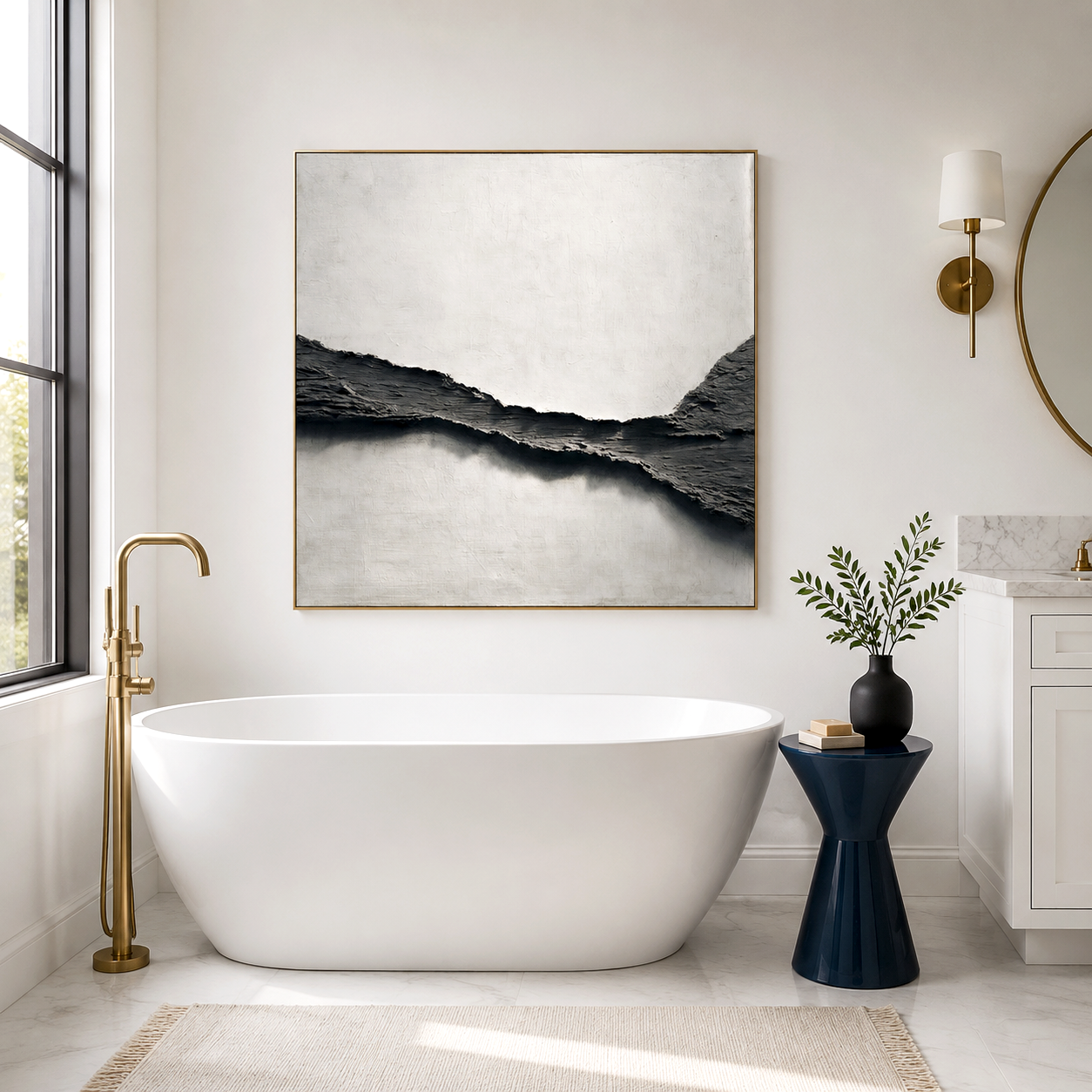
The distinction becomes important in design-led spaces where visible foam panels or office-style boards feel out of place. For those situations, options like Explore our Frame + Acoustic Art collection provide a more integrated approach—artwork that contributes to a softer acoustic environment without sacrificing the visual direction of the room.
When panels are enough and when they are not
Sound deadening wall panels work best in common interior scenarios: living rooms with echo, home offices with poor call clarity, or dining areas where conversation feels strained.
But there are limits.
A large, double-height space with glass walls and minimal furnishings will not be fully controlled by a few wall panels alone. The scale of reflection simply exceeds what small surface treatments can handle.
In more complex environments—restaurants, open-plan offices, or multi-use commercial spaces—acoustic comfort often requires a broader strategy. This can include ceiling treatments, soft furnishings, layout adjustments, and in some cases, consultation with an acoustic professional.
Panels are one part of a system, not a standalone fix for every acoustic problem.
The role of design in modern acoustic solutions
What has changed in recent years is not the physics of sound, but the expectations around design. People are less willing to compromise aesthetics for function.
Modern acoustic panels now come in forms that align with interior design goals—framed artworks, multi-panel compositions, and textured surfaces that visually soften a space while also reducing harsh reflections.
This modular approach allows flexibility. Instead of committing to a full wall treatment, panels can be arranged as a series of artworks, scaled to the room, and adjusted over time. It also makes acoustic treatment more approachable for residential spaces, where visual cohesion matters as much as performance.
Choosing panels for your specific space
Selecting the right acoustic wall treatment is less about brand or style and more about alignment with your room’s conditions.
Consider how the space is used. A home theater benefits from controlled reflections for clearer audio, while a living room may prioritize conversational comfort. Think about surface materials—tile, glass, and concrete increase reflectivity, while rugs and curtains already provide partial absorption.
Equally important is visual integration. Panels that clash with the interior often end up underused or poorly placed. Panels that feel like part of the design are more likely to be positioned correctly and in sufficient quantity.
For larger or shared environments, it can be helpful to get tailored guidance. If you are planning a multi-room or commercial project, you can Contact us for project advice to explore how decorative acoustic solutions fit into a broader design strategy.
Frequently Asked Questions
Can I use acoustic panels in a home theater?
Yes. Acoustic panels are commonly used in home theaters to control reflections, improve dialogue clarity, and create a more balanced listening experience. They do not replace speaker calibration but support it.
How many panels do I need to stop echo in my living room?
There is no fixed number. It depends on room size, ceiling height, and how many hard surfaces are present. A small room may improve with a few panels, while a larger open-plan space may require broader wall coverage and more strategic placement.