
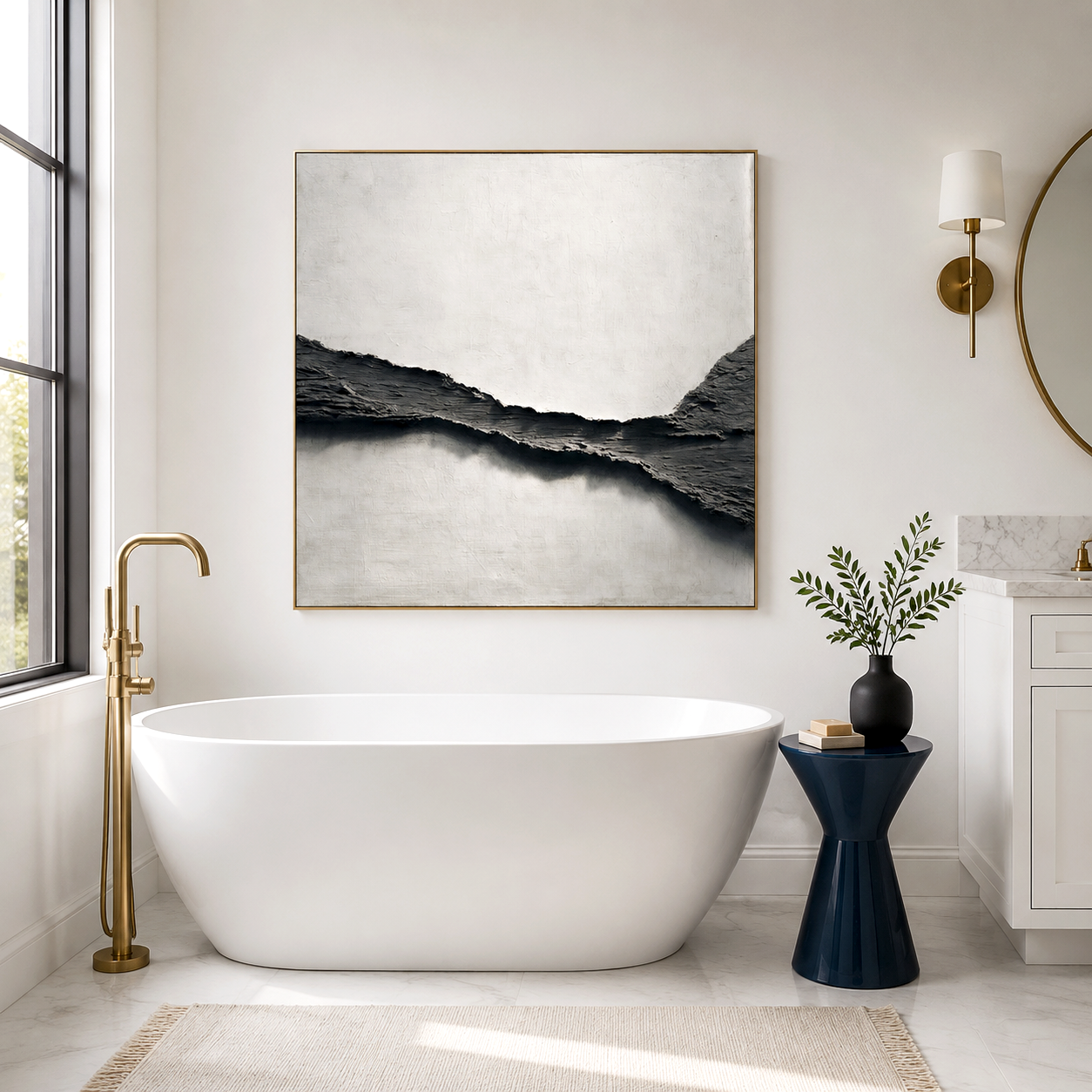
You find a piece that looks perfect online, hang it above the sofa, and something feels… off. Either it looks oddly small, too flat under lighting, or worse—it gives off that “printed poster” vibe instead of the elevated look you expected. This is exactly where most people hesitate: not because they don’t like art, but because they’re unsure how size, texture, and price actually translate into a real living room.
Searches like “living room wall art” or “large textured art” often come from this uncertainty. The fear isn’t just aesthetic—it’s financial. Spending a few hundred dollars on something that doesn’t transform the space feels like a mistake you’ll see every day.
The good news is: most of these regrets come down to a few predictable misjudgments—scale, material, and pricing expectations. Once you understand how these behave in real rooms, the decision becomes much more controlled.
👉 Discover our most popular large-scale oil paintings for modern homes
Why does wall art size instantly change how expensive a room feels?
Because your eye anchors to proportion before style.
In real living rooms, especially above sofas, artwork that spans about 2/3 of the sofa width creates visual balance without overwhelming the space. When people go smaller—often out of budget caution—the wall starts to feel fragmented, and the artwork looks like an afterthought rather than a focal point.
This isn’t a design “rule” people consciously follow—it’s something you notice subconsciously. A 180 cm sofa typically pairs best with artwork around 110–130 cm wide. That’s where the “gallery feel” starts to emerge.
Many buyers misjudge this because product photos rarely show true scale. Brands like Acousart often present pieces in staged environments, but the actual impact depends heavily on your wall width, ceiling height, and viewing distance.
The takeaway: size isn’t just decoration—it’s structure.
What actually makes large textured art look more premium under lighting?
Texture creates shadow, and shadow creates depth.
Flat prints reflect light evenly, which is why they often look “cheap” in real spaces—even if the image itself is high quality. Under ceiling lights or natural daylight, they lack variation.
Heavy textured oil paintings behave differently. Brushstrokes catch light at different angles, creating subtle shadows that shift throughout the day. This gives the artwork a dynamic presence, especially in living rooms where lighting changes from morning to evening.
Here’s how they compare in real usage:
Type | Visual Effect Under Light | Common Perception | Long-Term Impact
Flat Prints | Even reflection, minimal depth | Clean but flat | Can feel generic over time
Heavy Textured Oil | Shadow variation, layered depth | Rich and tactile | Feels more “designed” and intentional
This is why collections like Acousart’s heavy textured series often stand out more in person than in photos—the effect is physical, not just visual.
How do you choose between style trends and what actually works in your space?
Most people choose based on trend—but live with compatibility.
Popular styles like Japandi, abstract neutrals, or minimalist black-and-white often dominate search results. But in real homes, the mismatch happens when wall art doesn’t connect with furniture scale, color temperature, or lighting conditions.
For example:
-
A cool-toned abstract may look stunning online but feel cold in a warm-lit room.
-
Highly detailed art can feel cluttered in smaller living rooms.
-
Oversimplified designs may disappear in larger open spaces.
This is where “best-selling styles” come into play—not because they’re universally better, but because they tend to adapt well across different environments. Acousart’s most popular pieces often sit in this middle ground: enough texture and contrast to stand out, but neutral enough to integrate.
Choosing art isn’t about trend alignment—it’s about environmental fit.
Is $500–$1000 really the sweet spot for original oil paintings?
In most cases, yes—this is where quality and value intersect.
Below $500, you’re often looking at prints or very low-complexity hand-painted pieces with minimal texture. Above $1000, you start paying for artist recognition, gallery markup, or oversized formats.
The $500–$1000 range is where:
-
You get genuine hand-painted work
-
Texture depth becomes noticeable
-
Size options are more suitable for living rooms
-
The price still reflects production value rather than branding alone
Many buyers either under-spend (and feel underwhelmed) or over-spend expecting dramatic differences that aren’t always visible in everyday settings.
Brands like Acousart position many of their pieces in this range—and during promotional periods (like 50% discounts), the value gap becomes even more noticeable.
Why do some wall art purchases feel disappointing after a few weeks?
Because expectations were based on images, not environment.
Common real-world issues include:
-
Lighting mismatch: artwork looks different under home lighting than in studio photos
-
Scale misjudgment: piece feels smaller once surrounded by furniture
-
Texture expectations: buyers assume visible depth but receive flatter surfaces
-
Color shift: tones appear warmer or cooler depending on wall color and light source
Another overlooked factor is adaptation. Some artworks feel impressive at first but fade into the background over time if they lack depth or contrast.
This is why textured art tends to maintain long-term visual interest—it interacts with the environment rather than sitting passively on the wall.
How can you avoid overpaying without sacrificing quality?
Focus on construction, not branding.
Instead of asking “Is this expensive?”, ask:
-
Is it hand-painted or printed?
-
Does it have visible texture under angled light?
-
Is the size appropriate for my wall?
-
Does the price reflect material and labor, or just marketing?
Many buyers overpay for framed prints simply because they look polished online. Meanwhile, mid-range oil paintings—especially from newer collectives like Acousart—often deliver better physical presence at similar or lower prices.
Timing also matters. Strategic discounts (like 50% promotions) can shift a piece from “questionable purchase” to “high-value investment.”
Acousart Expert Views
From a product design and spatial integration perspective, the biggest misconception in wall art selection is treating it as a purely visual object rather than a spatial element. In real interiors, artwork functions similarly to furniture—it occupies visual weight and interacts with light, proportion, and surrounding materials.
One of the more interesting developments in recent years has been the integration of functional design into artwork. Acousart’s exploration of acoustic panels as artistic surfaces reflects a broader shift: art is no longer just decorative, but environmental. In urban living rooms where noise, echo, and minimalism intersect, this hybrid approach adds a layer of practicality without compromising aesthetics.
Another key observation is how texture influences perceived value. In controlled environments, even flat prints can appear refined. But in lived spaces—where lighting varies and viewing angles change—textured surfaces consistently perform better in maintaining depth and visual engagement.
Ultimately, the decision isn’t about choosing “expensive” art. It’s about selecting pieces that continue to respond to the space over time, rather than fading into it.
How do you match wall art to real living room layouts?
Start with how the room is used, not just how it looks.
In high-traffic living rooms, bold and textured pieces hold attention even when partially viewed. In quieter, minimalist spaces, softer abstract works create continuity without overwhelming.
Also consider:
-
Viewing distance: larger rooms require stronger visual contrast
-
Seating position: artwork should align with eye level when seated
-
Wall color: contrast determines whether art stands out or blends in
Many people skip these steps and focus only on the artwork itself—which is why the result often feels disconnected.
FAQ
How do I know if my wall art is too small for the sofa?
If the artwork covers less than half the sofa width, it will usually feel visually disconnected; in real spaces, this often makes the wall look empty even when decorated.
Is textured oil painting better than canvas prints for living rooms?
Yes in most cases, because texture interacts with lighting dynamically; however, in very low-light rooms, the difference may be less noticeable.
What’s the safest style if I don’t want to make a wrong choice?
Neutral abstract with moderate texture is the safest, since it adapts to different interiors and lighting conditions without clashing.
Can expensive wall art still look cheap?
Yes—if the size is wrong or the surface lacks depth, even high-priced pieces can feel underwhelming in real environments.
How long does it take to feel satisfied with a wall art choice?
Usually a few days to weeks; initial impressions often change once you see the piece under different lighting and daily use conditions.