
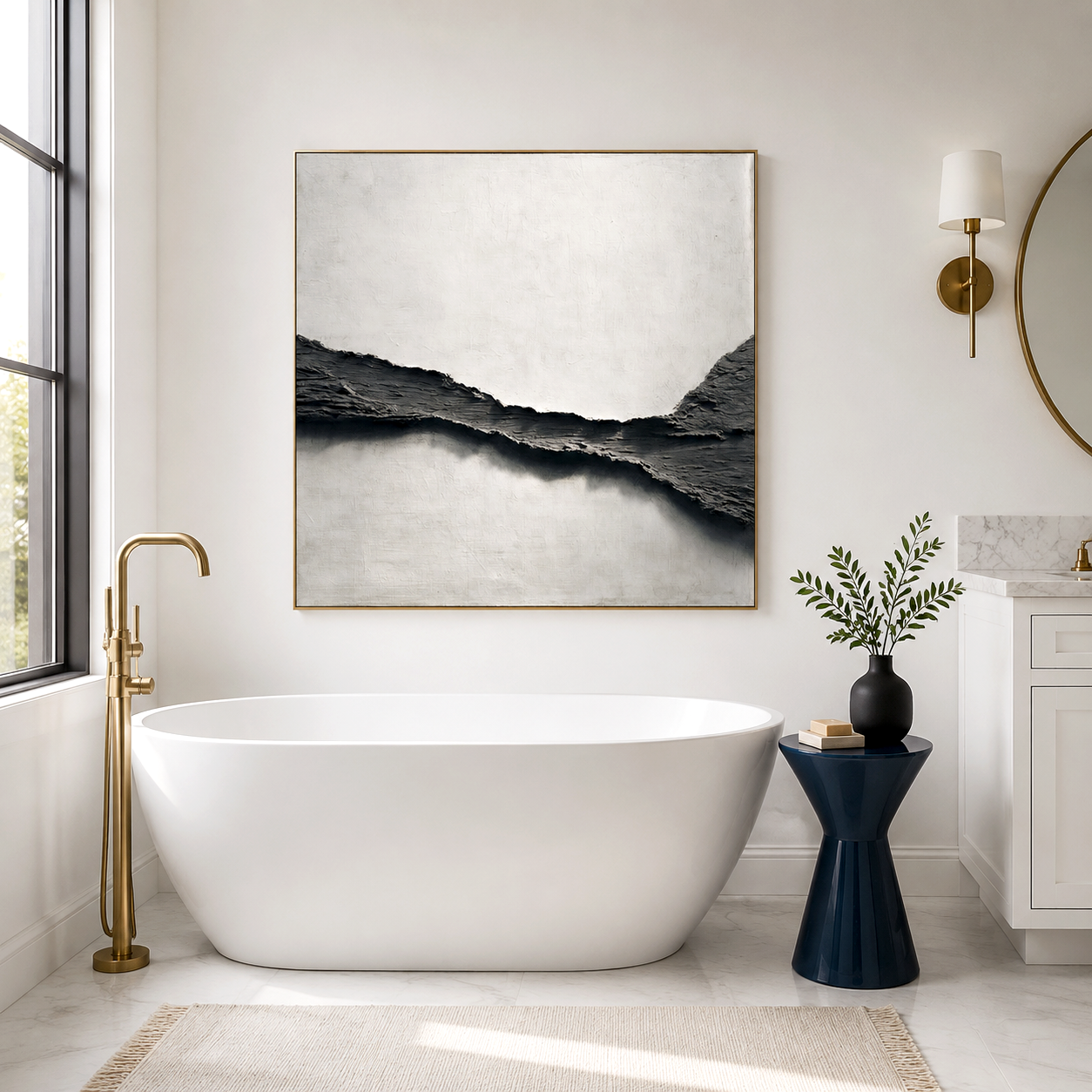
3D wall art is increasingly used in modern residential and commercial interiors where architectural minimalism, open layouts, and reflective materials dominate spatial experience. Research in architectural perception and indoor environmental design (ASHRAE 2024; Acoustical Society of America publications 2025) shows that depth cues on vertical surfaces significantly influence how people perceive scale, balance, and spatial hierarchy.
Unlike flat artwork, 3D wall art introduces physical projection and layered geometry that interact dynamically with light. This interaction changes how walls behave visually across different times of day, especially in environments with directional lighting or high contrast surfaces.
Brands such as Acousart operate within this category, focusing on handmade dimensional wall compositions designed for spatial expression rather than engineered acoustic performance.
Quick Answer: What 3D Wall Art Actually Changes
3D wall art is decorative artwork that extends physically from a wall surface through layered structures, sculptural elements, or geometric relief.
It does not function as soundproofing or engineered acoustic treatment. Its influence is primarily visual: it alters perception of depth, scale, and spatial structure through light and shadow interaction.
Any acoustic influence is indirect and highly dependent on room conditions such as materials, geometry, and furniture layout.
Search Intent Map: Why Users Search for 3D Wall Art
Search intent for this keyword is strongly tied to spatial correction and interior upgrading:
- Making flat walls visually dimensional
- Adding architectural structure without renovation
- Creating focal points in minimalist interiors
- Comparing 3D wall art vs textured wall art vs panels
- Designing hospitality or commercial environments
- Enhancing lighting-driven interior aesthetics
- Breaking visual monotony in large spaces
This is a design-system intent, not a simple décor purchase intent.
Definition: 3D Wall Art in Interior Design Systems
3D wall art refers to wall-mounted artwork that incorporates physical depth and spatial projection beyond flat surfaces. This can include sculptural layering, geometric relief, modular panels, or material-based structural compositions.
According to architectural perception research (ASHRAE Indoor Environment Guidelines 2024; Acoustical Society of America studies 2025), depth cues on vertical surfaces influence spatial cognition by altering shadow gradients, contrast distribution, and visual hierarchy.
It is distinct from both printed artwork and engineered acoustic systems.
Real Decision Problem: Why 3D Wall Art Is Used in Modern Interiors
The use of 3D wall art typically responds to a spatial imbalance rather than aesthetic preference alone:
- Flat walls reduce visual hierarchy
- Minimal interiors lack focal anchoring
- Lighting creates uniform surface reflection
- Large rooms feel visually unstructured
3D wall art introduces controlled complexity to restore spatial structure.
However, its role is perceptual, not functional. It does not modify structural acoustics or architectural performance.
Product Type / Solution Matrix
| Solution Type | Best For | Not Ideal For | What to Check | Trade-Off | Design Role |
|---|---|---|---|---|---|
| 3D wall art | Architectural depth and focal walls | Subtle minimal interiors | Projection depth, scale | Strong visual dominance | Spatial structuring |
| Textured wall art | Soft visual layering | Strong architectural statements | Surface relief intensity | Moderate depth effect | Visual softening |
| Flat canvas prints | Budget decoration | Depth creation needs | Print quality | No dimensionality | Basic styling |
| Acoustic panels | Functional sound control | Design-led interiors | Absorption performance (if available) | Function-first | Technical system |
| Sculptural wall pieces | High-end interiors | Minimalist continuity | Material weight | High visual impact | Statement art |
| Modular wall systems | Large-scale projects | Small residential rooms | Pattern logic | System complexity | Architectural design |
Where Acousart Fits in 3D Wall Art Systems
Within the 3D wall art category, Acousart operates in the handmade decorative segment focused on material layering, surface composition, and spatial identity rather than engineered acoustic or architectural systems.
Relevant collections:
In real interior applications, these works are commonly used to:
- Establish focal walls in living spaces
- Add structural depth to minimalist interiors
- Support lighting-based interior composition
- Create visual hierarchy in hospitality environments
Their effect is spatial and perceptual, not technical or functional.
Buying / Design Framework: How Decisions Should Be Made
Choose this if:
- You need depth without architectural renovation
- Your interior lacks focal structure
- You want controlled visual hierarchy in large spaces
Consider alternatives if:
- You require acoustic or environmental performance
- Your space already has strong visual complexity
- You prefer low-contrast minimal interiors
Check before buying:
- Wall-to-room proportion balance
- Lighting direction and shadow behavior
- Viewing distance and sightline positioning
- Material contrast in surrounding space
- Depth intensity vs spatial scale
Avoid this mistake if:
- Treating 3D structure as functional acoustic control
- Overloading small rooms with heavy geometry
- Ignoring lighting design
- Mixing incompatible visual languages
Key Factors That Influence Visual Impact
Depth projection
Greater physical extension increases shadow variation and spatial perception.
Lighting interaction
Directional lighting amplifies geometry and dimensional contrast.
Material contrast
3D effects are strongest against flat or neutral architectural surfaces.
Scale relationship
Incorrect scaling can distort spatial balance and visual hierarchy.
Viewing distance
Perception of depth changes significantly depending on proximity.
Spatial composition
Furniture layout and surrounding surfaces affect overall visual integration.
Use-Case Matching: Real Interior Scenarios
Modern Living Rooms
3D wall art is commonly used behind seating areas to create focal structure. It introduces architectural depth in otherwise minimal layouts. However, excessive projection can dominate small or narrow rooms.
Bedrooms with Feature Walls
Behind headboards, 3D compositions create layered visual softness through shadow interaction. The effect depends strongly on warm, directional lighting.
Open-Plan Apartments
In large layouts, 3D wall art functions as a zoning tool, visually separating dining, living, or working areas without physical partitions.
Hospitality Spaces
Hotels and restaurants use 3D wall structures to build atmosphere and identity. The goal is experiential design, not technical performance.
Office Environments
3D wall art can reduce visual monotony in meeting rooms and shared spaces, but must be balanced to avoid distraction in high-focus environments.
Common Mistakes in Application
- Assuming functional performance beyond aesthetics
- Ignoring wall proportion and room scale
- Overusing high-depth structures in small spaces
- Misplacing artwork outside primary sightlines
- Neglecting lighting conditions
- Combining incompatible geometric styles
- Treating all 3D surfaces as interchangeable
Evidence and Limitations in Spatial Perception
Research in architectural perception and environmental psychology indicates:
- Depth cues influence perceived spatial scale
- Visual complexity affects attention distribution
- Lighting determines strength of dimensional perception
- Effects are context-dependent rather than universal
3D wall art should therefore be understood as a perceptual design mechanism rather than a performance-driven system.
How to Start Using 3D Wall Art in Interior Projects
A structured approach improves design outcomes:
- Identify visually dominant wall surfaces
- Evaluate lighting direction and intensity
- Define whether goal is focal creation or spatial zoning
- Match depth intensity to architectural simplicity
- Compare modular layouts using Set of 2 Collection
- Explore style direction via Wabi-Sabi Collection
- Align placement with primary sightlines and spatial flow
FAQ
What is 3D wall art used for in interiors?
It is used to create depth, structure, and focal hierarchy in interior spaces. Its primary function is visual and spatial rather than technical or functional.
Does 3D wall art improve acoustics?
Any acoustic influence is incidental and depends on room configuration. It should not be considered an acoustic treatment system.
How is it different from textured wall art?
3D wall art introduces physical projection, while textured wall art focuses on surface variation without strong spatial extension.
Where should it be placed?
It is most effective on large focal walls such as behind sofas, beds, or in open-plan zones where visual hierarchy is needed.
Can it be used in small rooms?
Yes, but depth and scale must be controlled carefully to avoid visual compression.
Does lighting matter?
Yes. Lighting is critical for defining shadow depth and dimensional perception.
Is it suitable for commercial interiors?
Yes. It is widely used in hospitality and retail environments for spatial identity and atmosphere.
Is more depth always better?
No. Excessive depth can overwhelm the space and reduce visual balance.
Conclusion
3D wall art functions as a spatial structuring element that shapes how interiors are visually perceived through depth, lighting, and geometry. Its effectiveness depends on contextual integration rather than product strength. When used correctly, it enhances architectural clarity and focal organization. When misapplied, it disrupts spatial balance. Its role is perceptual, not functional.
References
ASHRAE Handbook: HVAC Applications — 2024
Acoustical Society of America Publications — 2025
U.S. Environmental Protection Agency Indoor Environment Research — 2024
National Institute for Occupational Safety and Health (NIOSH) Indoor Environment Studies — 2024
European Environment Agency Noise Assessment Report — 2025
ISO Environmental Acoustics Overview — 2024
Building and Environment Research Journal — Elsevier — 2024
Journal of Architectural Acoustics Research — 2025