
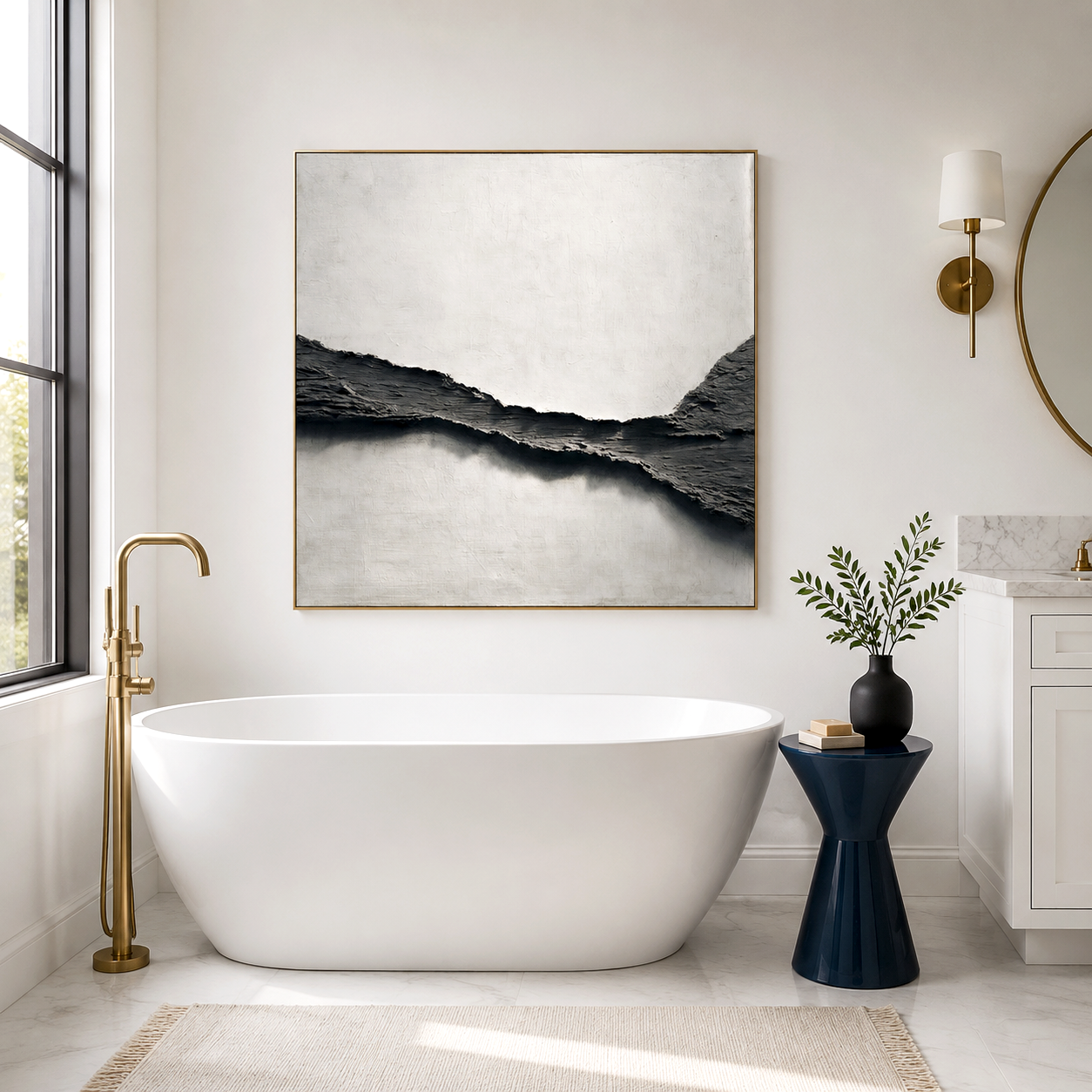
A large minimalist wall can look refined yet feel acoustically hollow. Flat prints sit on the surface, bounce light straight back, and leave conversations sounding sharper than expected. Plaster wall art changes that experience by adding physical depth. Hand-sculpted grooves and ridges interrupt both light and sound paths, creating a wall that feels active rather than inert. The result is not soundproofing, but a noticeable shift in how a room carries voices and how it handles daylight—less glare, less harshness, and a more grounded visual presence.
The echo of flat design in modern interiors
Minimal spaces often rely on drywall, glass, and stone—materials that reflect rather than absorb. When those surfaces dominate, voices travel cleanly across the room and bounce back with little interruption. A flat canvas print does almost nothing to change this behavior. Its surface is smooth, its ink layer slightly reflective, and its profile too thin to disrupt reflection paths.
Plaster wall art introduces relief. Even a few millimeters of height variation begins to break the “mirror” effect of a bare wall. In living rooms, dining areas, or meeting spaces where speech clarity matters, that difference is felt as reduced sharpness rather than silence. The room sounds more settled, not quieter in a measurable sense.
How rhythmic grooves disperse sound
The key is repetition. Parallel grooves, wave ridges, or concentric arcs create a field of small, angled surfaces. When speech hits that field, reflections scatter in multiple directions instead of returning as a single, strong echo. This is diffusion in a practical, design-led form.
Inside many contemporary plaster pieces, a concealed layered backing can also help trap some mid-to-high frequency energy. Combined with the surface geometry, this shifts the character of reflections so they feel less direct and less fatiguing over time. It is a subtle intervention, but in echo-prone rooms it is immediately perceptible.
In an open-plan apartment with a long, uninterrupted wall, replacing a single oversized flat print with a triptych of grooved plaster panels changed how conversations carried across the space. The room did not become silent; instead, voices stopped “snapping back” from the wall, and the overall atmosphere felt calmer during gatherings.
For those exploring sculpted options, the 3D abstract and plaster collections show how linear and wave-form reliefs are scaled and spaced for real walls rather than gallery-only pieces.
Why matte mineral plaster handles light differently
Light behavior is as important as sound. Flat prints often produce localized glare—especially in rooms with strong side lighting or large windows. Mineral-based plaster finishes are inherently matte, scattering light in many directions rather than reflecting it in a single beam.
This creates two visible effects. First, glare is reduced, which helps the wall read as soft and continuous rather than glossy and patchy. Second, shadows become part of the artwork. As the sun moves, ridges catch light at different angles, creating a slow shift in contrast that keeps a neutral palette from feeling static.
In beige, off-white, or black-and-white palettes, this shadow play is what gives minimalist rooms their sense of depth without adding color noise.
Groove depth and wall coverage in practice
Depth and coverage work together. A shallow, tightly spaced groove creates a fine diffusion texture; deeper, wider ridges produce stronger shadow lines and more pronounced scattering. Neither is universally “better”—they serve different rooms.
To keep decisions grounded, consider this practical framework:
-
Small rooms with close seating benefit from finer grooves and moderate panel sizes to avoid visual heaviness.
-
Large, open walls respond well to deeper ridges or multi-panel layouts that extend the diffusion field across a wider area.
-
As a general staging rule, covering roughly 10–15% of a dominant bare wall with textured relief can meaningfully change how the wall behaves without overwhelming the space.
Because each piece is knifed by hand, slight variations in ridge height are normal and contribute to the natural diffusion effect rather than detracting from it.
Designing with linear arrays instead of single statements
A single centered artwork can leave large areas of reflective surface untouched. Linear arrays—diptychs or triptychs—extend both the visual rhythm and the diffusion area.
A triptych of parallel grooves, aligned with consistent spacing, creates a continuous field that reads as one composition from a distance. Up close, the seams introduce subtle breaks that further disrupt reflection paths. This is particularly effective behind sofas, along dining walls, or in conference rooms where multiple listeners face the same direction.
For coordinated sets, the curated triptych set of 3 wall art offers proportioned groupings that are easier to place than mixing individual pieces from scratch.
Framing choices that support structure rather than compete with it
Heavy relief benefits from restraint around the edges. Floating frames in white, black, or natural oak create a boundary that sharpens the geometry without adding visual clutter. The gap between frame and artwork emphasizes depth, allowing shadows to “breathe” instead of being compressed.
Avoid ornate or deeply carved frames that fight the rhythm of the grooves. The goal is to keep the focus on the linear movement of the plaster surface and the way it interacts with light across the day.
Where plaster wall art fits and where it does not
Plaster-based reliefs are well suited to living rooms, bedrooms, offices, and hospitality interiors where you want a calmer acoustic feel without introducing industrial-looking panels. They pair naturally with minimalist textured neutral oil painting styles and contemporary plaster wall art relief in beige or monochrome palettes.
There are limits to respect. This approach does not block external noise or create speech privacy between rooms. Very large, highly reflective spaces may still require broader acoustic strategies beyond wall decor. And because of material sensitivity, heavy plaster artworks are not ideal for high-humidity environments such as pool houses or sauna-adjacent rooms.
A design-led path to calmer rooms
For minimalists and designers who want walls to do more than hold images, plaster wall art offers a credible middle ground. The combination of hand-sculpted grooves, matte mineral surfaces, and considered panel layouts introduces movement, reduces visual glare, and helps soften the sharpness of everyday conversation. It is a material solution that respects both the look of a space and how it feels to live in.